

A vague janitorial contract leads to poor service and unexpected bills, leaving you to manage friction rather than your facility. For property managers of high-traffic retail centers and commercial office buildings in the NYC and Philadelphia metro areas, a professional agreement defines exactly what you are paying for to keep your brand standards intact. If you are researching how to get janitorial contracts, a professional agreement is the first step.
The short answer
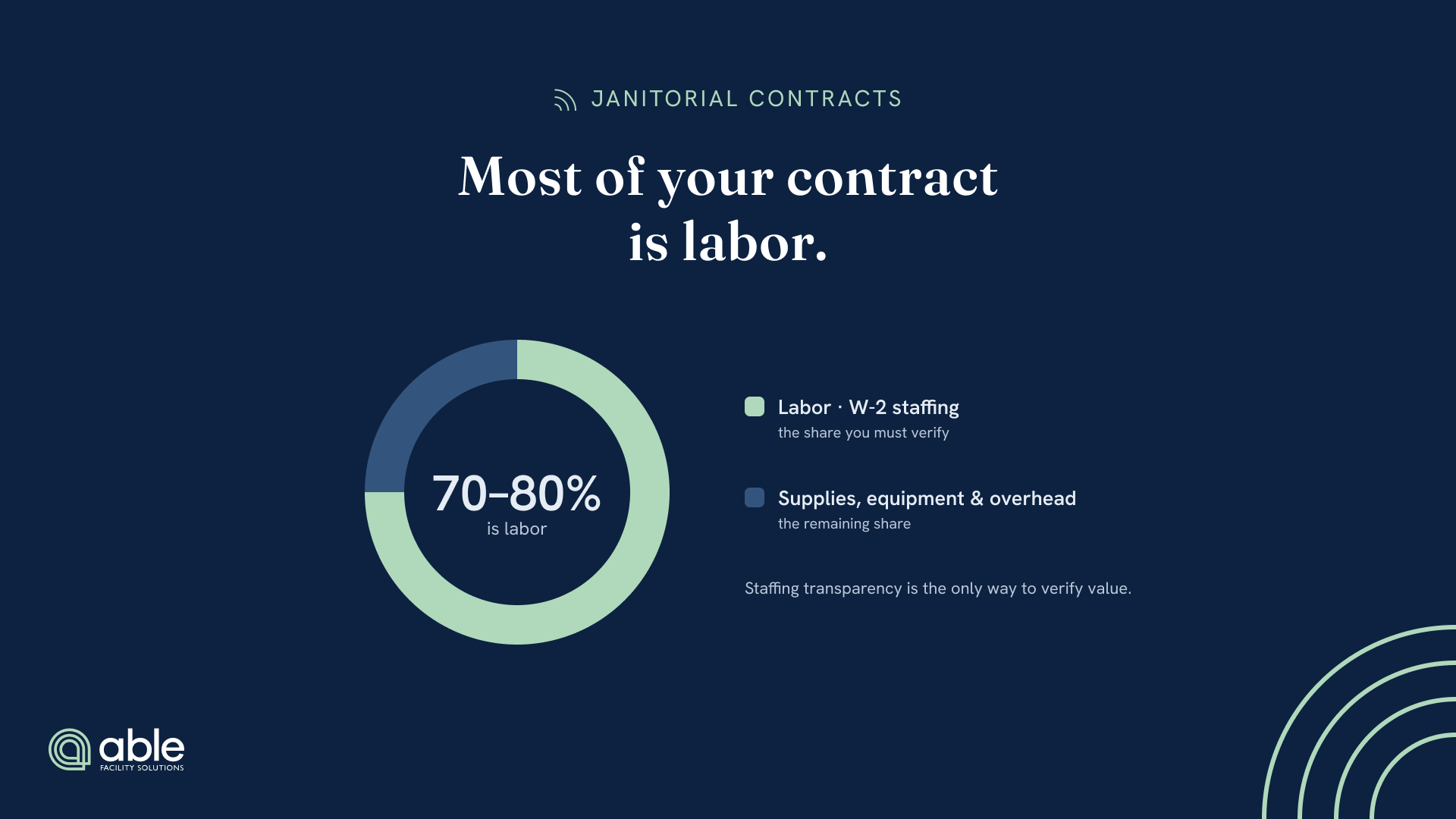
A professional janitorial contract is a logistical manual that itemizes labor allocation, task frequency, and W-2 staffing levels to normalize facility costs. Most comprehensive agreements include a detailed scope of work, excluding specialized services like VCT restoration or high-access window cleaning to prevent billing gray areas. Labor typically accounts for 70 to 80 percent of the total contract value, making transparency in staffing the only way to verify you receive the promised value. These janitorial cleaning contracts ensure that every dollar spent is accounted for in the budget.
The core components of a professional agreement
Commercial cleaning contracts must include a detailed scope of work, a task-frequency chart, and clear labor allocation for facilities management. Precision in the document also has immediate financial benefits. Contracts with specific frequencies reduce gray area billing by 15 percent according to Building Service Contractors Association International. Comprehensive agreements use standardized bidding processes to ensure all parties align on expectations from day one.
Essential components of janitorial contracts
Defined scope of work
The scope of work is the technical foundation of facility maintenance. It specifies every task by area, from lobby glass to mechanical room dusting. Detailed documentation prevents the scope creep that occurs when basic tasks are suddenly treated as extra billables. Property managers can use an itemized scope of work to draft these documents and keep budgets predictable. Specialized sectors often require manufacturing facility cleaning or data center cleaning to maintain operational safety.
Labor and frequency schedules
Frequency schedules dictate the total contract value and labor allocation. High-traffic office buildings need daily cycles for restrooms and lobbies, while low-traffic zones might only need weekly attention. A precise schedule helps the cleaning company manage its cleaning crew efficiently. For high-occupancy sites, you may need a dedicated day porter services for mid-day maintenance to handle the constant flow of visitors. Without a contract that specifies the hours dedicated to your site, you cannot verify performance against cost.
Exclusions and emergency clauses
Exclusions and add-on clauses protect both the client and the provider. Clear emergency service rates prevent budget overruns during unexpected issues like floods or spills. A professional provider will explicitly list what is not included, such as high-access window washing or specialized floor restoration like VCT strip-and-wax programs. Listing these avoids confusion during the billing cycle, especially in hospitality cleaning where standards are exceptionally high.
How to compare janitorial contracts without getting burned
| Contract feature | Standard model | High-accountability model |
|---|---|---|
| Labor type | Often 1099 subcontractors | Dedicated W-2 employees |
| Task tracking | Verbal assurances | Documented quality audits |
| Price structure | Flat monthly fee | Itemized frequency & labor |
| Quality guarantee | Best effort | 30-day performance guarantee |
FAQ
Common questions
- What does commercial cleaning consist of? It involves recurring tasks designed to maintain health and asset value, including floor care, trash removal, restroom sanitation, and high-touch point disinfection. This is critical for hospital cleaning services and general hospital cleaning.
- How are commercial cleaning rates calculated? Rates are based on square footage and production rates. Production rates measure how many square feet a worker can clean per hour. Costs also depend on the specific frequency required for each zone, whether in a California medical facility or a retail shop.
Review your current contract against these line items to ensure total facility coverage. A professional facility walkthrough can help verify your current service levels and identify areas where your current agreement may be falling short. Ready to secure your facility standards? Book a call with Able Facility Solutions today.