
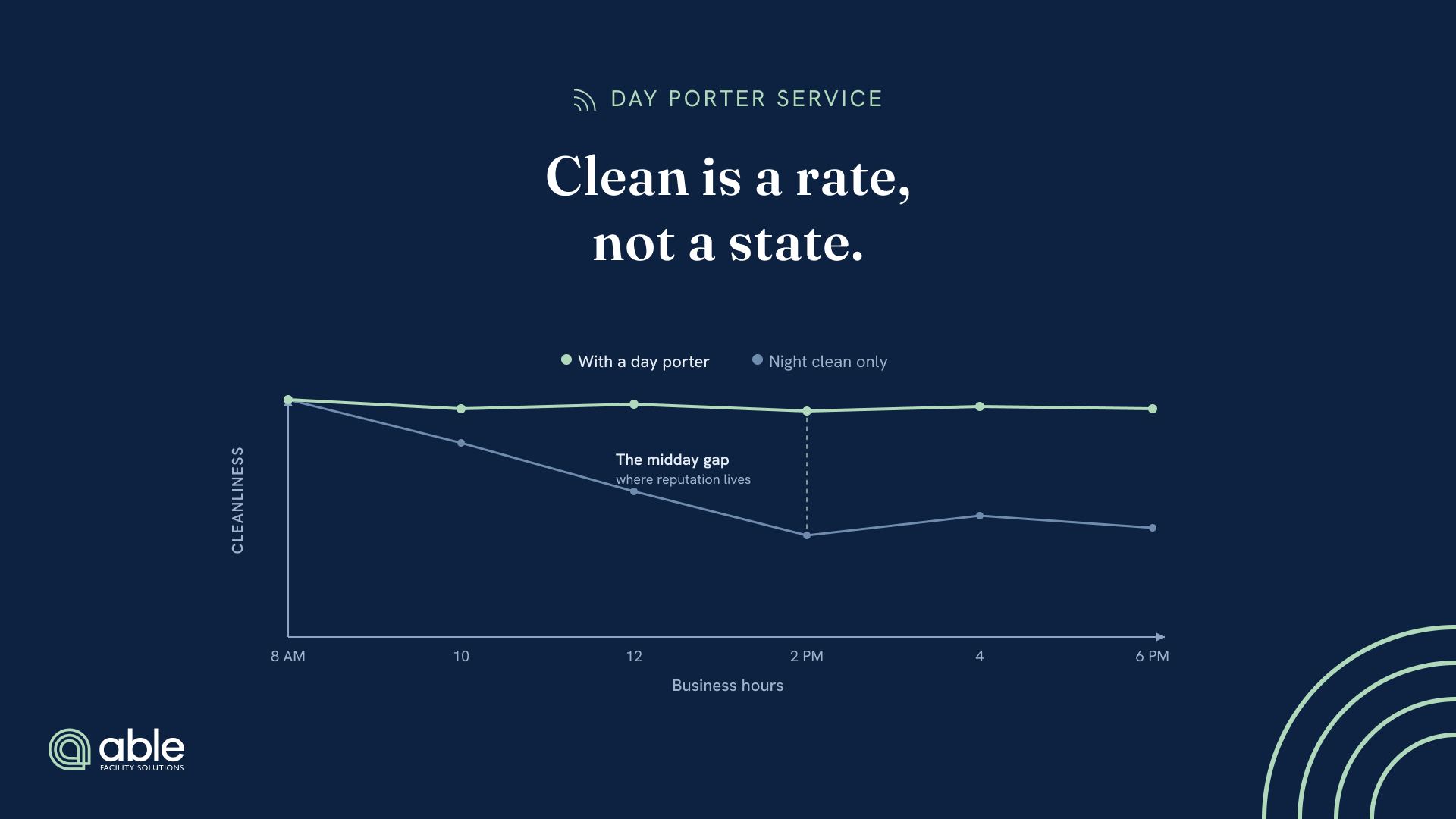
A pristine lobby at 8:00 AM means nothing if the restrooms are a disaster by noon. In busy facilities across NJ, NY, and Philadelphia, the time between nightly cleanings can make or break your reputation. I have found that most property managers treat cleaning as a binary event. They think the building is either clean after the night crew leaves, or it is dirty during the day. This is a liability.
Heraclitus made the point about rivers twenty-five centuries ago, in the one river fragment scholars accept as genuinely his:
“"On those who step into the same rivers, different and different waters flow."”
Heraclitus — fragment DK B12
The river keeps its name and its banks while none of its water stays. A building behaves the same way. The lobby at eight in the morning and the lobby at two in the afternoon share a floor plan and very little else.
The short answer: Day porter services provide a proactive, business-hours presence to manage facility upkeep in real time. Unlike reactive cleaning, a day porter keeps high-visibility areas clean and professional while the building is occupied.
What is a day porter? Defining the role
I recommend defining the day porter not as a janitor, but as an on-site facility technician. They focus on immediate support. While a night crew does deep cleaning every night. During business hours, the day porter keeps bio-load under control. The day porter also maintains appearance standards as they change throughout the day. They act as the bridge that maintains your building image when tenants and visitors are watching most closely.
Proactive vs. reactive maintenance
I call this approach "active asset protection." A reactive model waits for a tenant to complain about a spill or a lack of supplies before dispatching help. A proactive day porter monitors these needs before they become tickets, maintaining a constant loop of inspections. Using a proactive maintenance checklist allows staff to identify early warning signs of system decay before they escalate. This prevents the mid-day facility deterioration that often plagues high-traffic retail and commercial office environments.
The daytime presence advantage
Having a uniformed professional on-site does more than keep the floors dry. It shows tenants that the management team cares about their experience. In high-density environments where health is a priority, specialized campus day porter services provide the continuous disinfection necessary to reduce absenteeism. Facilities with staff on-site during the day have fewer long-term maintenance issues. Small problems, like leaks, get noticed within hours instead of days.
Day porter vs. janitor: Understanding the difference
It is critical to distinguish these roles to avoid operational overlap. Understanding the janitor vs. porter distinction helps managers ensure proper labor allocation. While one handles the deep clean, the other manages the live environment. This is like how an athletic director manages game-time logistics to ensure safety and crowd control. Integrating these roles into your broader commercial cleaning strategy is essential for total building health.
Service model comparison
| Feature | Janitorial Services | Day Porter Services |
|---|---|---|
| Operational Hours | After-hours (night) | Business hours (day) |
| Primary Focus | Deep cleaning/restoration | Maintenance and hygiene |
| Tenant Interaction | Zero to minimal | High visibility and support |
| Core Task | Floor waxing/carpet cleaning | Spill response/restocking |
The essential day porter checklist
To move beyond hygiene theater, your on-site support must follow a rigorous, technical checklist. This ensures that high-touch points are not just wiped, but properly disinfected according to required dwell times.
- High-touch surface disinfection: Constant rotation through elevator buttons, door handles, and lobby counters.
- Restroom maintenance: Monitoring and restocking paper products and soap every 2 hours at minimum.
- Immediate spill response: Mitigating slip-and-fall risks in real time.
- Trash mitigation: Emptying overflowing receptacles in common areas.
- Lobby and entrance upkeep: Ensuring the first point of contact remains spotless.
High-touch disinfection
I recommend using standardized facility cleaning checklists to track these rotations. In busy medical or corporate sites, the goal is to reduce germs on surfaces that hundreds of people touch each hour. This is a matter of health and safety compliance, not just aesthetics.
Common area upkeep
Maintaining common areas requires a balance of efficiency and discretion. The day porter must be trained to work around foot traffic without disrupting business flow. The porter must stay alert in public areas. This keeps the facility presentable throughout the afternoon. Determining the right ratio of daytime maintenance and night cleaning depends on your specific traffic patterns and brand standards. A well-trained porter becomes an invisible but essential part of the building ecosystem.
Why W-2 staffing matters for on-site support
Accountability is the primary differentiator in day porter services. Many national vendors rely on 1099 subcontractors, which creates a significant gap in oversight. Able Facility Solutions uses a fully W-2, employee-based workforce. This ensures the person representing your building is insured, vetted, and accountable to local management.
Subcontracted vendors often lack the technical training required for clinical-grade disinfection. By utilizing modern office disinfection standards that prioritize W-2 employees, you mitigate the risk of COI non-compliance. This direct line of communication is vital during emergencies like a major leak or a biohazard event.
Implementation: Integrating porter services
Transitioning to a hybrid model requires a strategic assessment of your building foot traffic. I recommend a phased approach:
- 1Conduct a foot traffic audit to identify peak usage times for restrooms and lobbies.
- 2Define specific day porter cleaning tasks based on your building's unique high-touch points.
- 3Establish clear communication protocols between your facility manager and the on-site porter.
- 4Review your office cleaning frequency to determine if a full-day or half-day porter is required.
Day porters are not a luxury; they are a fundamental component of asset preservation for any modern facility. To learn how a daytime program, with a 30-day guarantee, can protect your building’s value, schedule a walk-through with a facility expert. Comprehensive janitor services are most effective when paired with this daytime support.
Not sure what your facility needs? Use our 60-second tool to build a tailored cleaning recommendation and cadence.