
Most facility managers view maintenance as a line-item expense for "trash and dash" services. In reality, a professional program is a restorative system designed to protect your building's most expensive assets. When you manage busy retail centers or office buildings in NYC, NJ, and Philadelphia, vendor quality matters. A vendor who only empties bins differs from one who provides technical maintenance. That difference shows in longer-lasting assets and better tenant retention. Utilizing professional commercial cleaning services ensures that these high-visibility environments remain both hygienic and durable.
The short answer
Professional commercial cleaning is a technical discipline that utilizes specialized technology, EPA-registered chemicals, and W-2 management to maintain institutional health and safety standards. Unlike basic janitorial services, it focuses on long-term asset preservation through restorative maintenance cycles. This approach mirrors the careful prevention used in a home appliance maintenance checklist. Scheduled HVAC and water heater inspections help prevent major failures.
What is commercial cleaning? beyond the janitorial bucket
In my experience, the confusion starts with the terminology. Many managers use "janitorial" and "commercial cleaning" interchangeably, but they represent different scopes of work. Janitorial services are typically the daily, repetitive tasks performed by commercial janitors. These include emptying trash, cleaning restrooms, and vacuuming common areas. While essential, these tasks alone do not address deep-seated contaminants or the physical degradation of surfaces over time.
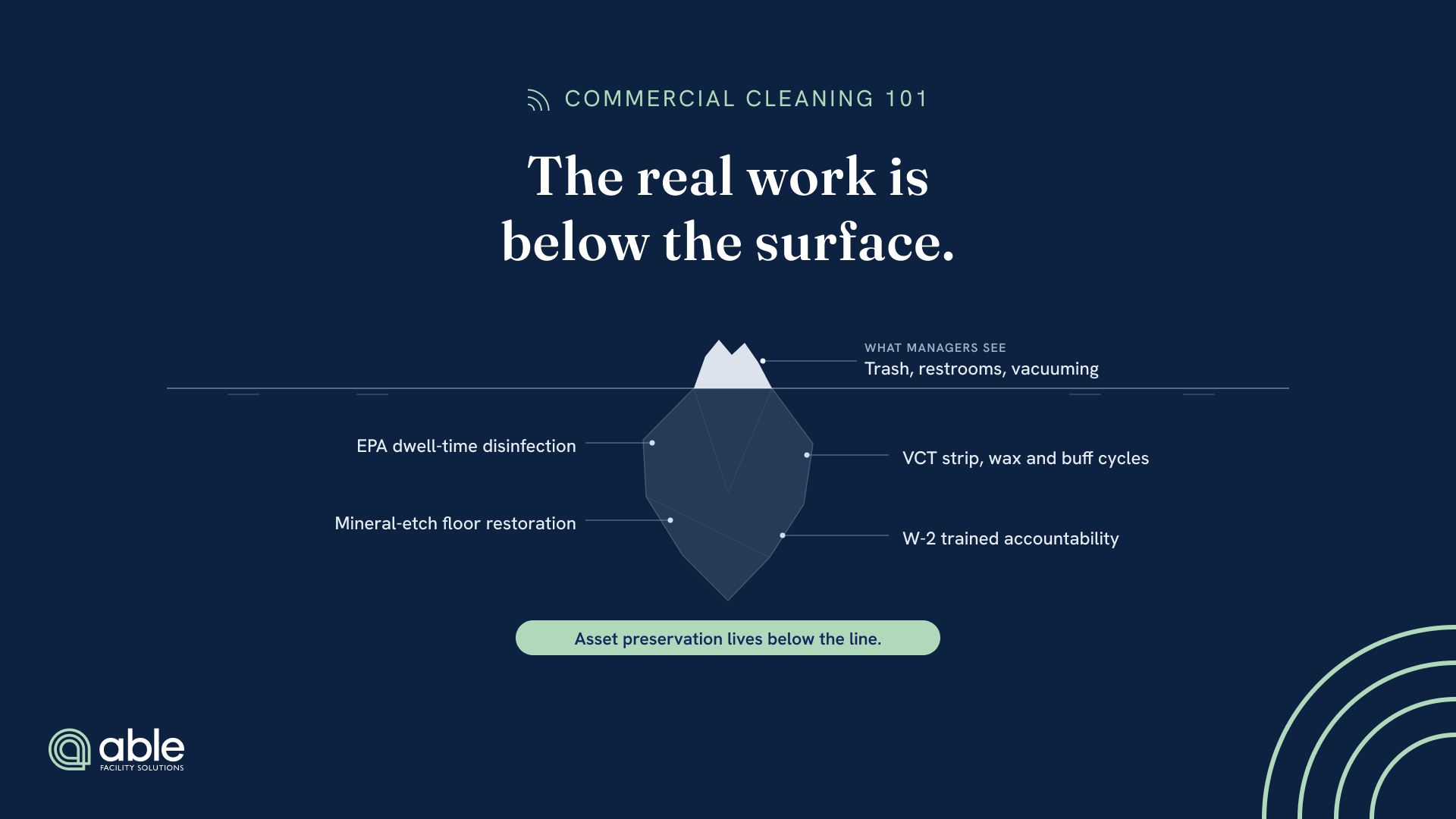
Daily janitorial vs. specialized services
Commercial cleaning encompasses specialized services that require technical training and specific equipment. This includes high-level window washing, upholstery steam cleaning, and comprehensive commercial office cleaning for sensitive environments. For example, a retail center needs more than a daily mop. It requires a structured approach to maintain hygiene in high-touch areas while protecting expensive architectural finishes from wear. Organizations that want to scale these operations often weigh the pros and cons. They review business expansion models to keep quality control across many sites.
The role of EPA-registered disinfectants
Professional contractors must understand the science of dwell times. Simply spraying a surface and wiping it immediately is not disinfecting. Proper disinfection requires the chemical to remain wet on a surface for a specific duration to kill pathogens. I have found that 30% of facility managers prioritize employee health as a top metric. This is largely because professional cleaning can reduce sick days by 46% and boost productivity by 12%. Technical expertise in chemical application is a health and safety imperative, not just a cosmetic preference. Many organizations now prioritize hiring green commercial cleaners to ensure these health benefits. They use sustainable, non-toxic products.
The restorative system: protecting asset longevity
The most significant risk to your budget is the hidden cost of floor care neglect. A staggering 37% of contracts lack formal floor care programs. This omission leads to premature asset degradation. It also forces managers into expensive off-contract retail markups for emergency VCT maintenance. A restorative system treats your floors as an investment rather than a surface.
Philip Crosby built a career on exactly this accounting error. His 1979 book carried the argument in its title, and the line beneath it is the one facility managers should hold onto:
“"Quality is free. It's not a gift, but it's free. The 'unquality' things are what cost money."”
Philip Crosby - *Quality Is Free*, 1979
VCT maintenance and strip-and-wax cycles
Vinyl Composition Tile (VCT) requires a specific cadence of stripping and waxing to maintain its protective barrier. If this barrier fails, dirt and grit act like sandpaper and permanently damage the tile. I recommend facility managers use commercial floor care services that prioritize W-2 workers. This helps ensure these technical cycles are done correctly. When managing large-scale restoration, many firms now evaluate investing in 3D laser scanning. This helps capture precise floor dimensions and asset locations before work begins.
Mineral etching and long-term floor care
In regions like Philadelphia and NJ, winter salt and heavy foot traffic introduce abrasive minerals into your facility. Without professional floor cleaning in commercial buildings, these minerals can etch stone and tile surfaces. Standard mopping cannot undo this damage. Developing a custom facility cleaning plan helps managers plan labor around usage patterns. It ensures specialized needs, like mineral removal, are handled in a planned way.
Service comparison table
| Service aspect | Standard janitorial | Restorative facility solutions |
|---|---|---|
| Floor care | Reactive mopping | Scheduled strip, wax, and buff cycles |
| Disinfection | Spray and wipe | Verified dwell times with EPA-registered chemicals |
| Labor model | Subcontracted 1099 staff | Trained W-2 employees |
| Goal | Visible cleanliness | Asset preservation and health |
Why W-2 labor is the industry gold standard
The "broker" model relies on rotating 1099 subcontractors. This model is the primary cause of inconsistent sanitation standards. I have consistently seen that high-accountability self-performance is the only way to meet APPA medical-grade standards. Prioritizing W-2 labor for risk management is the best way to remove hidden insurance gaps. It also reduces liability risks linked to subcontracted labor. This approach is particularly important when selecting commercial janitorial services to maintain long-term facility health.
Procurement checklist: evaluating commercial cleaning contractors
If you are auditing your current services, follow these five steps during your next walk-through:
- Review the labor model to confirm if staff are W-2 employees or subcontractors. Able Facility Solutions utilizes a fully W-2 workforce to ensure accountability.
- Inspect the VCT for signs of yellowing or baseboard wax buildup, which indicates poor technique. Using a strategic partner selection framework can help you identify vendors with the right technical expertise.
- Verify the inventory of EPA-registered disinfectants and check for proper dilution systems.
- Ask for a written floor care schedule that includes frequencies for buffing and burnishing. A specialized office cleaning service will provide this documentation upfront.
- Evaluate the contract line items to ensure labor hours match your building square footage by reviewing commercial janitorial contract line items.
Common questions
How often should my VCT floors be stripped and waxed?
Generally, high-traffic areas need a full strip and wax once or twice a year. Monthly buffing helps maintain the finish. However, this depends on your specific traffic patterns and soil load.
What is the difference between sanitizing and disinfecting?
Sanitizing lowers bacteria to safe levels, while disinfecting kills more pathogens. Both need proper dwell time and surface prep to work. Following a strict technical hierarchy of cleaning helps staff use the right chemicals. They use them in the correct order. It helps reduce biological risks and protects facility assets.
Why does the labor model matter for insurance?
Subcontractors often have gaps in their liability and workers' compensation coverage. A W-2 workforce eliminates these hidden risks for the property owner.
Not sure what your facility needs? Use our 60-second tool to build a tailored cleaning recommendation and cadence.