
Stop mopping your warehouse floor. You are likely destroying the seal and creating a slip hazard with every stroke. Industrial floors are a major capital investment. Yet many facility managers clean them with the same basic chemicals used in the breakroom. This approach leads to chemical etching and surface dulling that eventually causes a total failure of the floor system.
The short answer
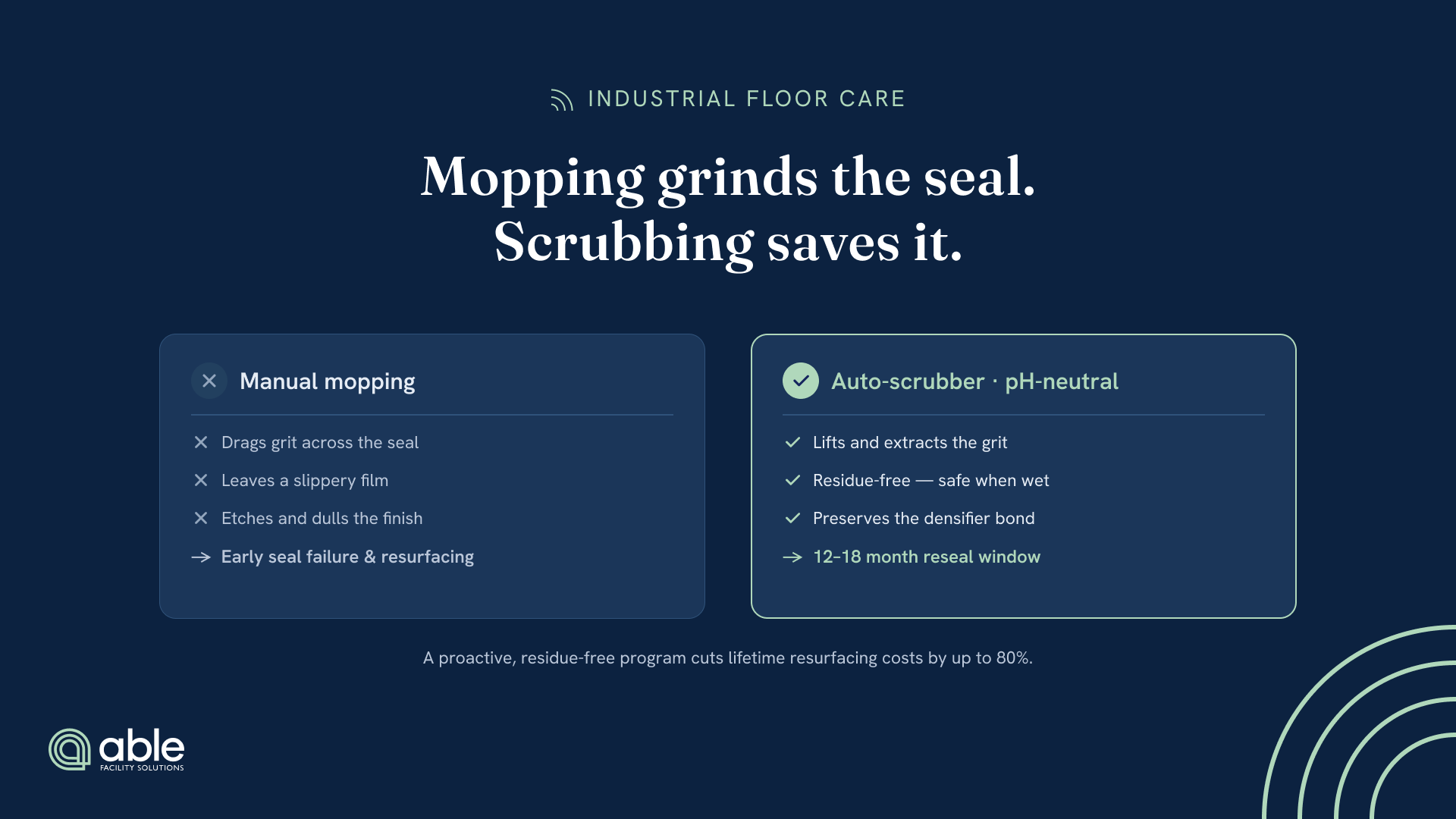
Effective industrial floor care requires pH-neutral chemistry and mechanical scrubbing rather than manual mopping. Maintaining polished concrete and epoxy surfaces means protecting the sealer’s chemical bond. It also means removing gritty debris before it acts like sandpaper. Most facility teams save 5x in resurfacing costs simply by switching to a residue-free cadence.
The science of polished concrete cleaning
Generic cleaners cause chemical etching on polished concrete surfaces because these floors rely on a densifier bond. This bond is easily disrupted by acidic or highly alkaline solutions. To maintain surface gloss, you must use pH-neutral cleaners specifically formulated for densified concrete. If the gloss is already fading, use a commercial floor types care guide. It can help you see if the damage is chemical or mechanical.
Mechanical auto-scrubbers are essential for removing abrasive industrial grit. Manual mopping is largely ineffective in a warehouse because it simply redistributes fine particulates across the floor. These particles are trapped under the mop and dragged across the seal, creating micro-scratches. Regular use of an auto-scrubber helps keep abrasive debris off the surface. It ensures that commercial floors are refinished less often. In my experience, the cost of the machine pays for itself in floor longevity within eighteen months.
Maintaining epoxy floor care and sealed surfaces
Epoxy coatings require specific non-filming detergents to prevent slip hazards. Many store-bought cleaners leave a soapy film that lowers friction. This can make the floor dangerously slippery when wet. This residue also attracts more dirt, creating a cycle of rapid resoiling. Proper commercial floor care services focus on residue-free chemistry to keep the floor safe and clean.
- Residue-free detergents prevent the buildup of slippery films on epoxy.
- Mechanical agitation lifts embedded oils from porous concrete sections.
- High-volume rinsing ensures that dirt is removed rather than moved.
- Abrasive management involves industrial mats at every transition point.
- Documented frequency prevents the localized wear patterns common in high-traffic bays.
- Institutional standards like those found in global cleaning benchmarks ensure consistent quality across multiple sites.
Industrial floor maintenance comparison
| Floor type | Primary maintenance tool | Cleaning frequency |
|---|---|---|
| Polished concrete | Auto-scrubber (pH neutral) | Daily / Every shift |
| Epoxy coating | Non-filming detergent | Daily |
| Sealed VCT | Burnisher and damp mop | Weekly |
| Raw concrete | Industrial sweeper | Daily |
Protecting the warehouse floor maintenance investment
Consider the 2026 commercial restroom construction cost per square foot alongside your main floor footprint. Preservation is the only way to protect your margins. Your 2026 commercial restroom build-out cost per square foot should include ongoing maintenance. This helps avoid early replacement. High commercial restroom construction costs per square foot in 2026 make a standard program a necessity, not an option. Every dollar spent on commercial floor care saves significant capital in the long run.
Benjamin Disraeli, the British statesman whose political discipline was built on the principle that ignored problems compound into crises, said something that applies to warehouse floors as directly as it did to Victorian budgets:
“"The greatest good you can do for another is not just share your riches, but to reveal to him his own." - Benjamin Disraeli”
I often see teams ignore the technical side of their floor until the dust becomes a safety issue. By then, the seal is gone. You can avoid this by following a technical stripping and waxing schedule adapted for industrial traffic.
FAQ
How do I protect my industrial floor construction investment?
Preservation is key to managing the 2026 commercial restroom build out cost per square foot and broader facility expenses. You protect the investment by using pH-neutral chemicals and mechanical scrubbers that remove grit without scratching the seal. A proactive maintenance plan typically reduces long-term resurfacing costs by 80%.
How often should I refinish industrial floors?
It depends on traffic, but high-volume warehouses usually need a deep scrub and reseal every 12 to 18 months. You can extend this window by using proper daily techniques. If you need a partner who understands industrial maintenance, contact the experts at Able Facility Solutions today.
Why is mopping bad for warehouse floors?
Mopping is not effective because it lacks the pressure needed to lift industrial oils. It can also spread fine grit across the surface. This grit acts as an abrasive, grinding down the polished finish or epoxy seal over time. Auto-scrubbers are the industry standard for a reason: they pick up the dirty water instead of leaving it to dry into a film.
What is the best cleaner for polished concrete?
Only use pH-neutral cleaners specifically designed for densified concrete. Avoid acidic cleaners or strong degreasers unless you are doing a specific restoration. These products can etch the surface and ruin the gloss. Ready to protect your facility floors? Book a call with Able Facility Solutions today.