
In high-stakes educational facilities, a low-bid cleaning contract often leads to compliance failure and fast asset damage. I have analyzed dozens of school cleaning tenders. I found that price-per-square-foot is a dangerous metric when you separate it from accountability. This guide provides a framework for evaluating cleaning services for schools. It is based on risk, technical expertise, and the need for a W-2 workforce model.
The short answer: what defines a qualified school cleaning partner?
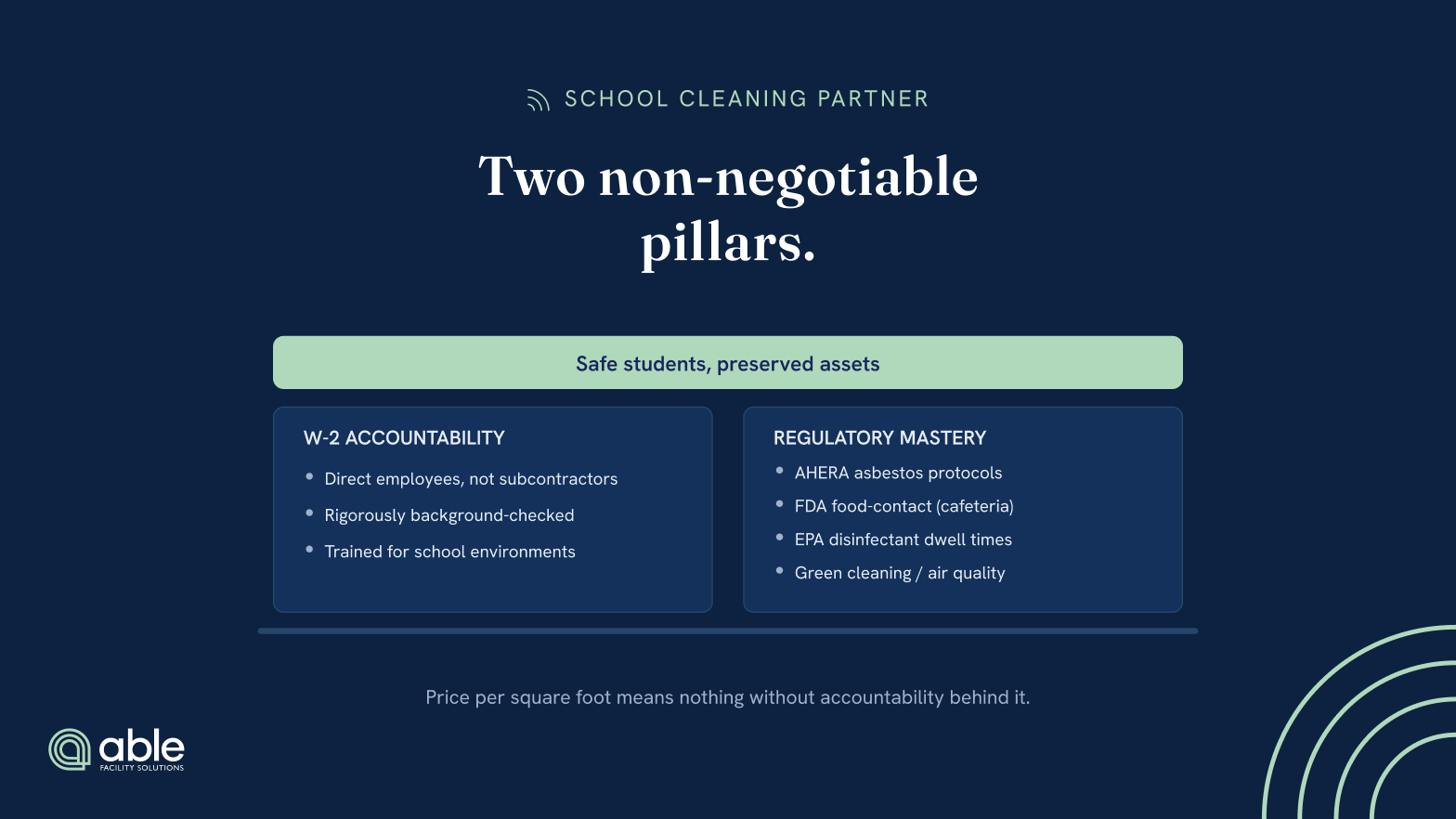
A qualified partner prioritizes safety and health over mere appearance. Generic janitorial firms focus on visible trash. However, an institutional-grade provider focuses on reducing viral loads and preserving assets. Recently, I learned that the best administrators focus on two must-have areas. They hold W-2 employees accountable. They also have strong knowledge of regulations.
Accountability through W-2 labor
I recommend avoiding vendors who rely on subcontracted labor. Subcontractors often lack the specialized training required for educational environments. They also create big gaps in background check verification. A W-2 workforce model ensures that every cleaner is a direct employee. This means they are subject to rigorous vetting and consistent performance reviews.
Regulatory compliance mastery
Educational facilities are governed by strict mandates that generic cleaners often ignore. A qualified cleaning company for schools must show they know AHERA asbestos protocols and green cleaning mandates. Failing to follow these standards does more than just result in a dirty building. It creates significant legal and health liabilities for the district.
Beyond the bid: understanding school cleaning costs
Procurement directors often face pressure to accept the lowest bid, which typically ranges from $0.07 to $0.17 per square foot. However, these figures rarely account for the hidden costs of high absenteeism or premature flooring replacement. I have reviewed facility budgets. Shifting focus to evidence-based custodial scoping can create long-term savings. It also supports student health and extends the life of VCT assets.
Cost vs. risk comparison
| Factor | Low-Bid Subcontracted Model | Value-Based W-2 Model |
|---|---|---|
| Labor Accountability | Low (subcontracted) | High (direct employees) |
| Background Checks | Often self-certified | Rigorously verified |
| Training Standards | Minimal/Generic | Specialized for schools |
| Long-term Asset ROI | Low (rapid depreciation) | High (preservation focus) |
The compliance checklist: AHERA, FDA, and green mandates
When evaluating school cleaning companies, you must move beyond general janitorial skills. Schools are unique because they involve vulnerable populations and crowded environments. According to ISSA, effective school cleaning pays dividends. It leads to lower absentee rates and better public perception.
To ensure your vendor meets these high standards, verify the following:
- Adherence to AHERA asbestos management protocols during floor maintenance
- Use of EPA-registered disinfectants with appropriate dwell times for viral load reduction
- Compliance with FDA food contact standards for all cafeteria and kitchen surfaces
- Implementation of green cleaning mandates to protect indoor air quality
- Documented background check protocols for all on-site personnel
Asbestos and AHERA protocols
If a contractor improperly strips a floor containing asbestos-lined tiles, they risk a total building shutdown. I have found that specialized commercial floor care expertise is vital. It is the only way to ensure these high-risk tasks are performed safely.
Cafeteria and FDA food contact surfaces
High-traffic cafeterias require more than just a wipe-down. Janitorial services for schools must use chemicals that are safe for food contact surfaces. These chemicals must also be effective against common pathogens. This requires a technical understanding of manpower ratios and chemical dilution. Most residential-grade cleaners simply do not have this knowledge.
Technical floor care: preserving VCT and high-traffic assets
Educational facility cleaning is largely a battle against floor wear. High-traffic hallways require specific expertise in VCT maintenance. This is especially true regarding production rates and finish coats. If the finish is applied incorrectly, the floor becomes porous and traps dirt. This leads to permanent staining. I recommend selecting a partner that understands how to manage the building envelope. They should protect your most expensive interior assets.
Mobilization: the 30-60-90 day review framework
Sustainable school cleaning services depend on structured oversight during the transition period. I recommend following this three-step framework to ensure quality scores match the initial proposal:
- 1Day 30: Do a baseline facility audit to confirm all W-2 staff are trained on site safety rules.
- 2Day 60: Review high-traffic sanitization logs to ensure cafeteria and gym disinfection meets FDA and EPA standards.
- 3Day 90: Conduct a technical review of floor care outcomes to confirm that finish coats are maintaining asset integrity.
What to do next
Selecting a cleaning company for schools is an exercise in risk management. By prioritizing W-2 accountability and technical compliance, administrators protect both their students and their budgets. Many cleaning companies for schools fail to meet these rigorous standards. Furthermore, commercial cleaning contractors must be vetted for their specific experience in educational environments.
- Review your current contract for subcontracting clauses and labor model transparency.
- Verify that your vendor has a documented AHERA compliance plan for floor maintenance.
- Request a facility audit from Able Facility Solutions to identify gaps in your current sanitation program.
Contact our team today to schedule a walkthrough of your campus.