
In a clinical setting, the difference between looking clean and being sanitary affects liability and patient safety. Facility managers often make the mistake of treating sanitization as a standalone fix for high-traffic zones. Applying chemical treatments to a surface that has not been properly prepared is a waste of both budget and effort. Professional medical office cleaning must follow a strict protocol to be effective.
Sanitization and disinfection fail on soiled surfaces
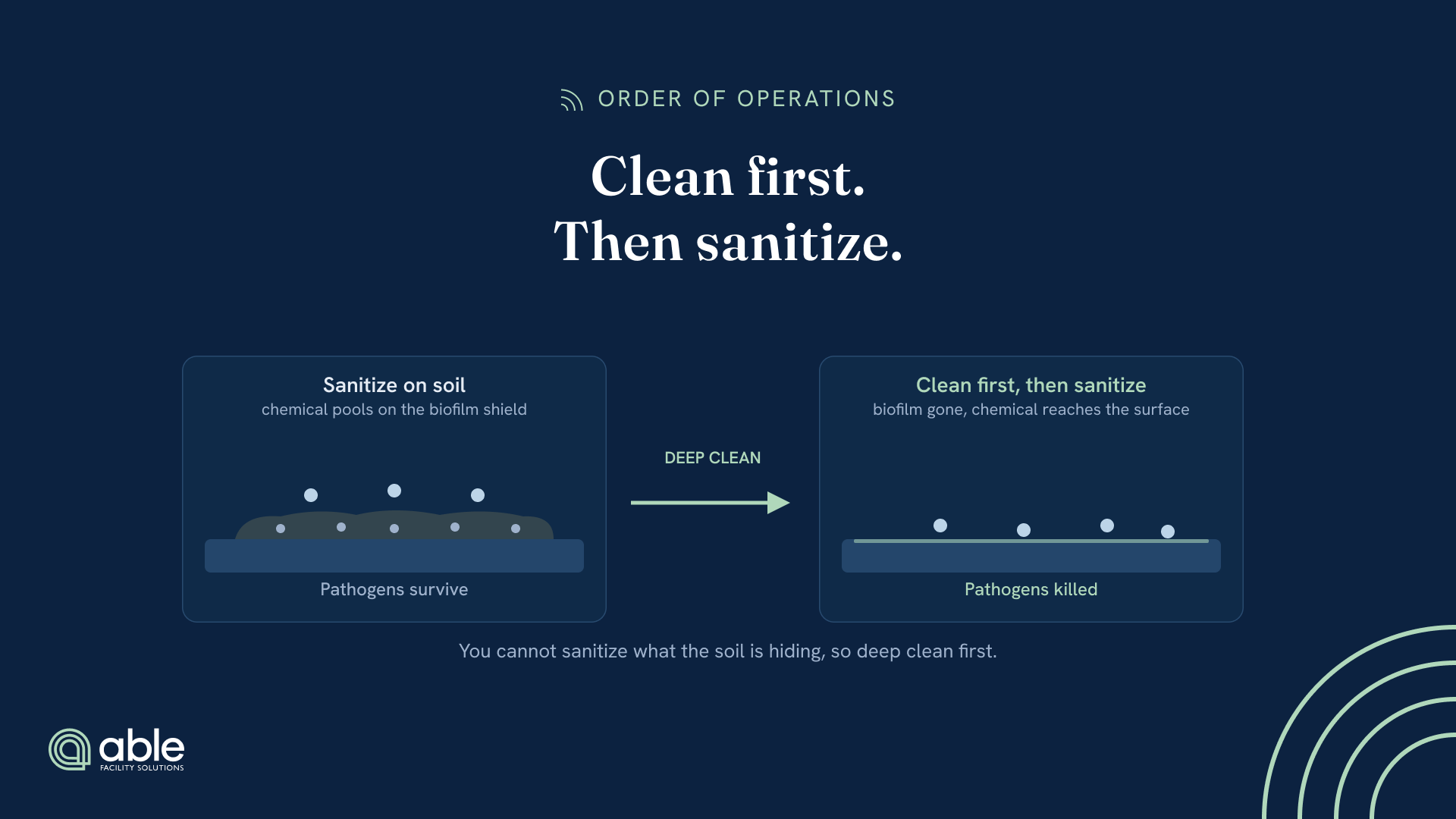
Sanitization is a technical process designed to reduce bacteria to safe levels. However, it requires a clean substrate to work. If a surface contains organic grime or biofilms, pathogens remain protected beneath the debris. Deep cleaning must occur first to remove physical matter. This is followed by sanitization or disinfection to address the microbial load.
I view facility hygiene as an engineering problem. You cannot achieve the desired result without following the correct order of operations. According to the technical hierarchy, cleaning removes germs and dirt. Sanitizing lowers germ levels to a safe level. Medical cleaning ensures all protocols are met by following these distinct stages.
Method comparison table
| Method | Target | Primary Action | Required Dwell Time |
|---|---|---|---|
| Cleaning | Physical debris and soil | Mechanical removal | None |
| Sanitizing | Bacteria (safe levels) | Chemical reduction | 30-60 seconds |
| Disinfecting | Bacteria, viruses, fungi | Total elimination | 3-10 minutes |
Removing the biofilm foundation
Biofilms are complex clusters of bacteria that adhere to surfaces. They act as a shield. This shield makes many liquid sanitizers ineffective upon contact. If a crew skips scrubbing and removing dirt during a deep clean, the chemicals cannot reach the surface. The crew is wasting expensive chemicals on top of the dirt.
Deep cleaning uses special detergents and mechanical force to break bonds between particles and the surface. Healthcare cleaning services that prioritize this step reduce the risk of cross-contamination. Removing the organic load ensures subsequent sanitization steps actually reach the surface. Adopting a clinical-grade cleaning checklist ensures technical compliance beyond aesthetics.
Pathogen reduction standards
Effective medical office cleaning requires this layered approach. Without the deep clean, pathogens can survive even the most aggressive chemical applications. Engineered cleaning programs treat soil removal as a technical prerequisite rather than a cosmetic choice. During peak viral periods, facilities benefit from proactive electrostatic defense strategies to ensure 360-degree coverage.
Strategic deployment: when to deep clean vs. sanitize
Strategic layering of medical office cleaning services optimizes facility budgets. Applying high-intensity disinfection only to high-risk zones prevents overspending on low-touch areas. Just as restaurant cleaning requires strict adherence to food safety codes, clinical spaces demand precise execution.
- Clinical bays: Requires daily deep cleaning followed by high-level disinfection.
- Waiting rooms: Daily sanitization of high-touch points with weekly deep cleaning of upholstery and floors.
- Restrooms: Continuous disinfection protocols for all nonporous surfaces.
- Administrative offices: Routine cleaning with targeted sanitization of shared equipment.
Floors are the largest horizontal surface in any facility. Proper maintenance prevents mineral etching. It also keeps the surface nonporous. Understanding the rules for cleaning vs. sanitizing vs. disinfecting is essential. This helps stop pathogens from getting trapped in the substrate. Without this technical distinction, standard medical facility cleaning becomes nearly impossible to validate.
Common questions about healthcare sanitation
What are EPA-registered disinfectants?
These are chemical products tested and regulated by the EPA to kill specific pathogens. For janitorial services in a medical setting, you must verify the product label. Choosing the right hospital janitorial service starts with checking the product label. Make sure it lists the viruses or bacteria you identified in your risk assessment.
Why does dwell time matter so much?
Every chemical has a specific dwell time. This is the duration it must remain wet on a surface to be effective. If a crew wipes a disinfectant away too quickly, the microbial kill rate drops to near zero. This compromises your healthcare cleaning services.
How does W-2 labor affect compliance?
Accountability is the bedrock of clinical safety. Unlike 1099 crews, a dedicated W-2 workforce undergoes rigorous training in technical disinfection standards. This model ensures that technicians follow dwell time protocols every single time. To maintain these standards at scale, organizations often use micro-content for frontline training to improve performance metrics.
Next steps for facility managers
- 1Conduct a site audit to identify high-touch vs. low-touch risk zones.
- 2Review your current chemical dwell times and verify technician compliance.
- 3Transition to a W-2 labor model to ensure professional accountability.
- 4Schedule a deep clean of all floor substrates to remove existing biofilms.
Not sure what your facility needs? Use our 60-second tool to build a tailored cleaning recommendation and cadence for medical cleaning services.
We are onboarding five new facilities this month and applying a 10% reduction to the first contract term for each. It is a limited intake so we can give proper attention to the transition. Once those five places are filled, we return to standard rates.