
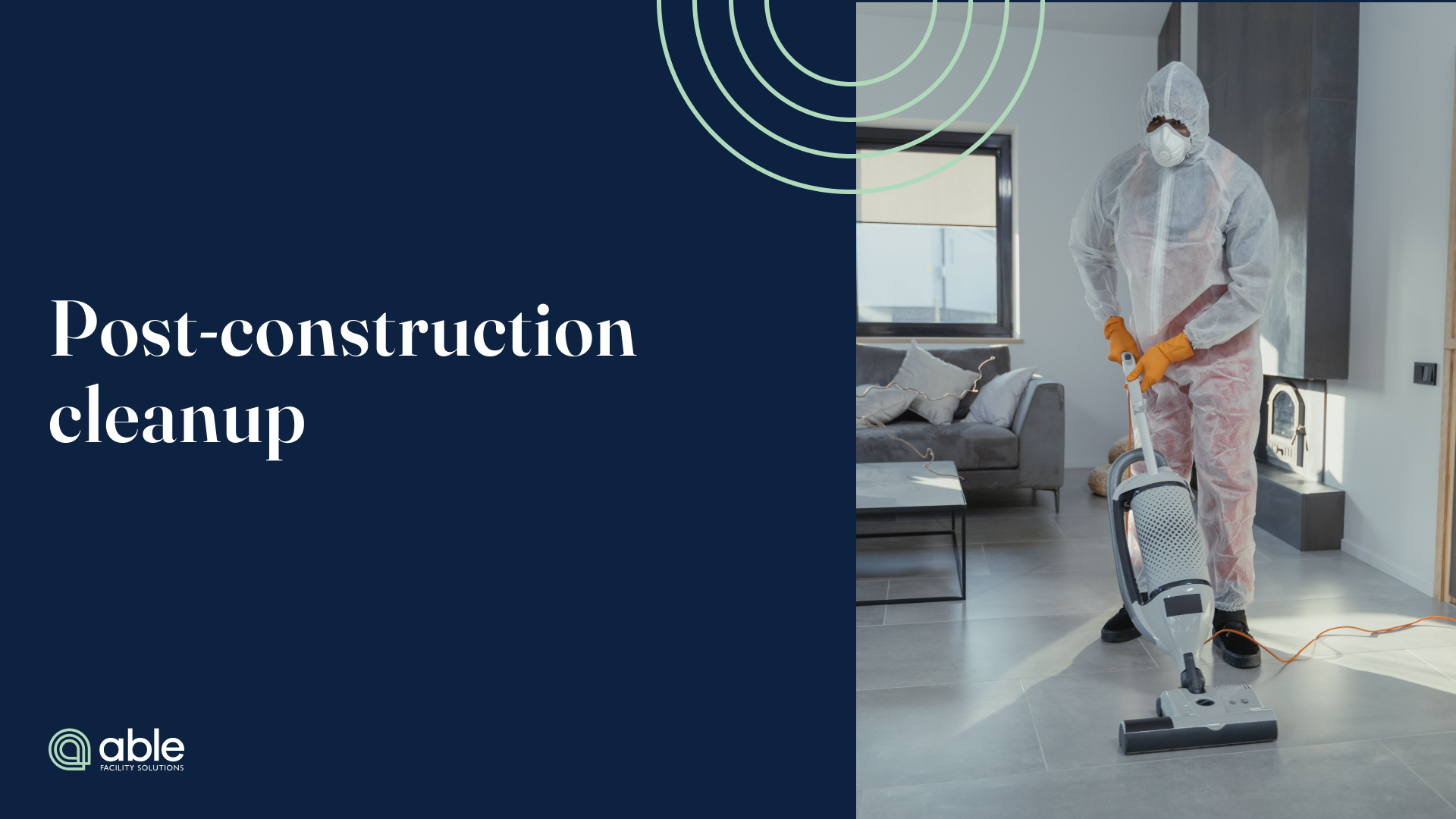
I have analyzed dozens of retail handovers where the finished space was actually a liability. Most developers mistake a swept floor for retail readiness. However, the real risk lies in what you cannot see, including fine particulate dust, chemical residue, and hazardous debris. For commercial developments in the Tri-State area, achieving a retail-ready state requires a technical, three-phase cleanup.
Post construction cleanup for retail spaces follows clear steps. It includes rough debris removal, deep interior cleaning, and a final shine. This process ensures the space is free of construction-specific hazards and meets branding standards for occupancy. Success depends on hiring professionals who follow OSHA safety rules. They also use HEPA filters to protect indoor air and new finishes.
The three phases of post construction cleanup services
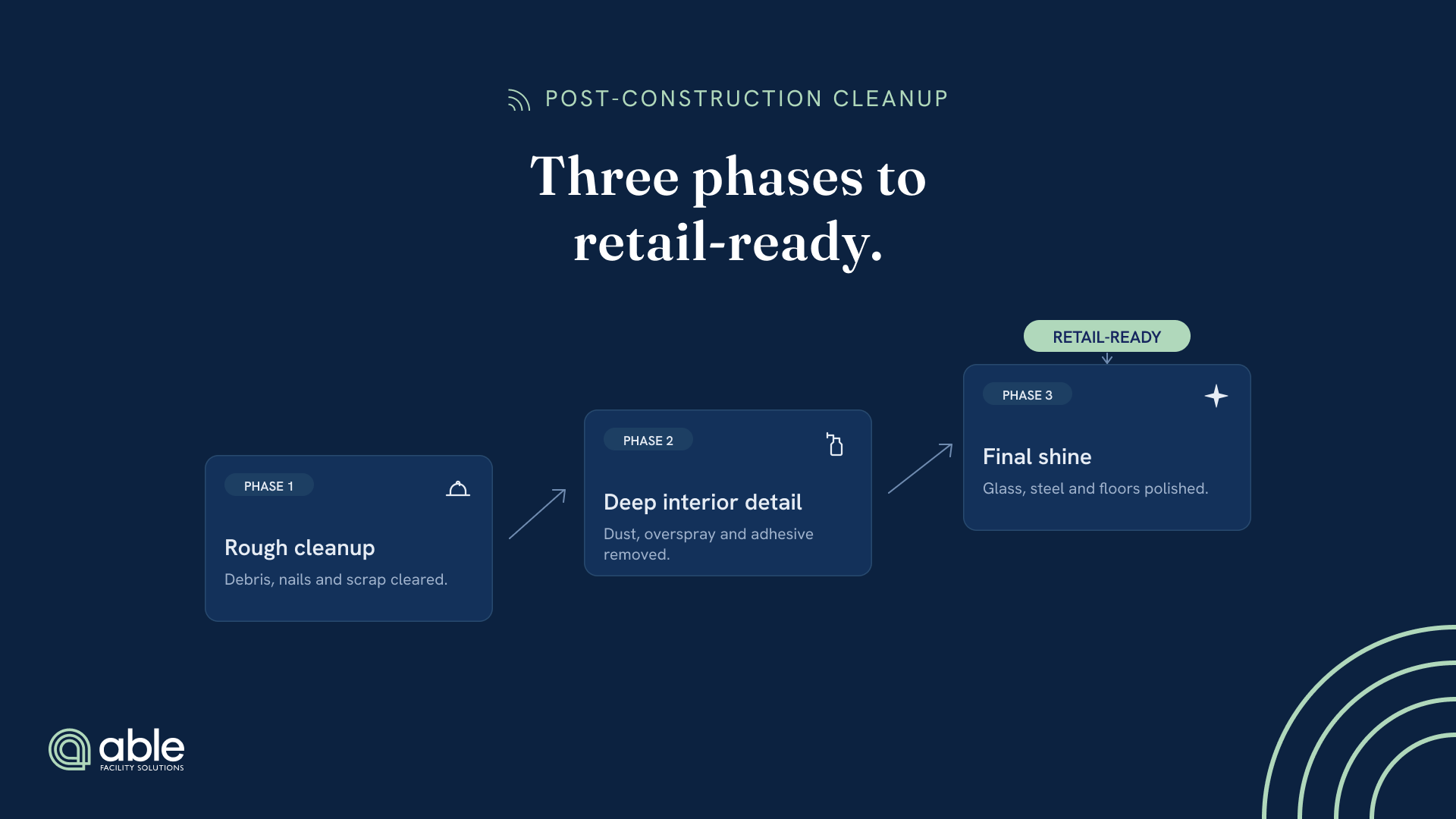
Phase 1: rough cleanup and debris removal
This initial stage focuses on clearing abandoned items, protruding nails, and large scrap. It includes the first pass at cleaning storefronts and ensuring restrooms are operational for subsequent trades. If debris is not cleared properly, subsequent trades risk injury and project delays.
Phase 2: the deep interior detail
This phase addresses the technical cleaning of all surfaces. It involves removing stickers, paint overspray, and the fine dust that settles in HVAC ducts and recessed fixtures. In my experience, skipping this detail leads to permanent scoring of expensive VCT assets and millwork.
Phase 3: the final shine for occupancy
The last step is a careful polish of all high-visibility surfaces, including glass, stainless steel, and floors. This helps meet city inspection needs and brand standards. The phased transition from rough to final is where most projects fail.
The final shine is a critical requirement for high-visibility retail branding. Without this phase, municipal inspectors may flag safety issues. The retail tenant's brand image is also compromised before the first customer enters the doors.
Executing these phases in the correct sequence prevents dust from settling on finished surfaces. A structured timeline for waste removal and closeout photos provide the documentation needed for life-safety sign-offs. I recommend following a comprehensive cleaning punch list to ensure no technical detail is overlooked during the transition.
Why standard housekeeping fails the retail-ready test
Standard housekeeping protocols are designed for daily maintenance, not the aggressive environment of a construction site. Construction dust is often abrasive and chemically complex. If a crew uses residential-grade vacuums or incorrect wiping techniques, they risk scratching expensive new finishes. Furthermore, a firm specializing in commercial office cleaning typically uses different chemical ratios than those required for post-construction environments.
They may also spread fine particulates into the building's HVAC system. My analysis shows that failing to use HEPA-standard equipment leads to EPA-classified indoor air quality problems. These particulates can trigger respiratory issues for future occupants and lead to premature wear on mechanical systems.
The hazard is old enough to have been documented five centuries ago. Georgius Agricola catalogued the diseases of miners in *De Re Metallica*, published in 1556, and was unambiguous about what airborne particulate does:
“"If the dust has corrosive qualities, it eats away the lungs, and implants consumption in the body."”
Georgius Agricola - *De Re Metallica*, 1556
A professional construction cleaning company understands that retail readiness is an asset preservation strategy. This is especially true for high-traffic storefronts where brand standards are paramount. If asset preservation is ignored, capital expenditure for surface replacement increases significantly.
Hazard mitigation and OSHA compliance in commercial cleaning
Safety in post-construction environments is a regulatory mandate. When vetting commercial cleaning contractors, facility managers must verify specific safety programs. I suggest that facility directors treat EMR ratings as a major requirement for these high-risk sites.
- Verification of OSHA 29 CFR 1926.20(a) accident prevention programs.
- Documented respiratory protection plans in compliance with 29 CFR 1926.103.
- Use of covered, OSHA-compliant containers for all caustic or acid-based cleaning agents.
- Deployment of screens or tarps to contain dust during abrasive floor cleaning services for commercial applications.
- Clearly defined safety supervision present on-site during all cleaning phases.
The W-2 advantage: accountability in the Tri-State area
Accountability is a major factor in high-stakes retail handovers. Relying on a model that utilizes 1099 subcontractors creates a gap in safety supervision and liability coverage. A W-2 self-performed model ensures each technician is trained in specific hazard mitigation. It also provides one point of contact for multi-site portfolios. Able Facility Solutions backs this accountability with a 30-day guarantee to ensure brand standards are met.
Labor model risk comparison
| Factor | W-2 Self-Performed Model | 1099 Subcontracted Model |
|---|---|---|
| Safety Supervision | Direct, on-site oversight | Minimal to non-existent |
| Liability Coverage | Comprehensive corporate policy | Fragmented or absent |
| Training Standards | Verified OSHA certifications | Self-certified or generic |
| Accountability | Single point of contact | Multi-tiered finger-pointing |
Managing the transition to retail-ready standards
Structured timelines and detailed closeout photos are essential to prevent occupancy delays and ensure life-safety sign-offs. If your current provider is not meeting these technical requirements, consider a structured vendor transition. To audit your current cleaning partner's readiness, follow these steps:
- Request a copy of their written respiratory protection plan (29 CFR 1926.103).
- Verify that all workers on-site are W-2 employees with documented OSHA training.
- Confirm that the proposal includes a dedicated final shine phase with HEPA filtration equipment.
- Establish a clear onboarding roadmap for the first 90 days to verify quality audits.
Common questions about post construction cleanup
Why is HEPA filtration necessary for retail readiness?
HEPA-standard equipment is required to capture fine silica and drywall dust that standard vacuums recirculate. Without it, these particles settle on new VCT assets and enter the HVAC system. This can cause long-term indoor air quality issues.
Can standard janitorial crews handle post-construction work?
I recommend against using daily maintenance crews for construction closeouts. They usually do not have the strong alkaline strippers or mechanical equipment needed. This makes it hard to safely remove alkaline residue and construction-grade adhesives.
Ready to transition your commercial development to retail readiness? Book a call with Able Facility Solutions today.