
Most facility managers view cleaning as a line-item expense to be minimized. In my experience, this perspective costs thousands in premature asset replacement. The quality of an asset-preservation cleaning program is a primary predictor of a building's lifespan. Shifting focus from aesthetic tidiness to technical asset stewardship transforms janitorial work into a strategic investment.
The hierarchy this inverts is older than any building you manage. Vitruvius, writing around 27 BC, set out three conditions a structure must satisfy:
“"Well Building hath three Conditions; Commodity, Firmness, and Delight."”
Vitruvius - *De architectura*, c. 27 BC (Henry Wotton's translation, 1624)
The short answer
Integrated facility maintenance treats cleaning as a preventative measure rather than a sunk cost. By using an in-house W-2 workforce, I have found that facilities can make expensive surfaces last longer. VCT is one example. Using floor care protocols also helps extend the life of these surfaces. This technical approach creates a measurable ROI through capital preservation and reduced emergency replacement costs.
The shift to preventative maintenance
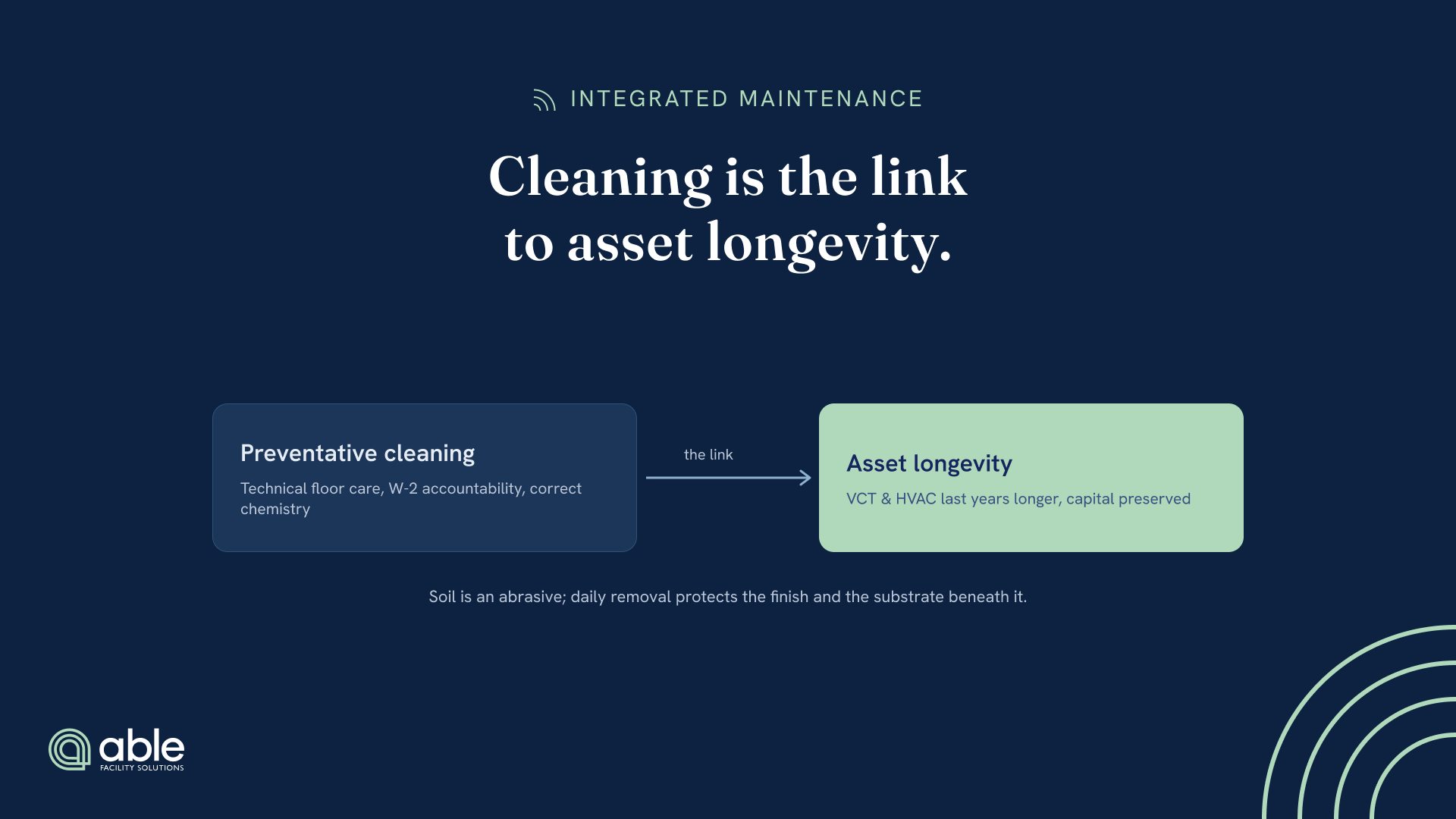
Technical floor care and self-performing W-2 workforces mitigate the environmental degradation of expensive surfaces like Vinyl Composition Tile. I recommend treating soil as an abrasive that must be managed daily. When dirt lingers on high-traffic floors, it grinds away protective finishes. This commercial floor care failure leads to permanent degradation.
Integrated cleaning protocols are essential for preventing premature replacement of facility assets like VCT and HVAC components. Once the top layer is damaged, germs can get trapped in the porous material. This makes the surface hard to disinfect well. I have found that this specific failure point is where most facility budgets begin to bleed.
Extending the VCT lifecycle
Proper maintenance cycles protect Vinyl Composition Tile. Facilities that neglect stripping and waxing schedules often face capital-heavy replacements five years ahead of schedule. An integrated janitorial service plan ensures protective coatings are replenished before the substrate is damaged.
Comprehensive janitorial services manage every square foot for durability, preserving the capital budget for other improvements. I have found that neglecting these cycles causes permanent floor degradation, forcing capital-heavy replacements years ahead of schedule. By maintaining a technical schedule, managers can avoid the emergency costs of substrate failure.
The cost of the subcontracting trap
Self-performing teams ensure that technical standards like dwell times and chemical ratios are met, unlike subcontracted labor. This accountability is critical for preserving assets.
Operational metric comparison
| Operational metric | Subcontracted cleaning | W-2 integrated maintenance |
|---|---|---|
| Quality control | Low / Fragmented | High / Direct |
| Asset knowledge | Minimal | Technical / Deep |
| Accountability | Broker-based | Direct employer |
| ROI focus | Short-term savings | Long-term preservation |
3 steps to audit your facility maintenance plan
- 1Review floor care cadence to ensure it matches actual restroom traffic patterns.
- 2Evaluate a partner's ability to integrate industrial facility maintenance tasks like electrical repair or HVAC monitoring.
- 3Confirm cleaning crews use correct chemical ratios to avoid surface etching.
FAQ
What is integrated facility maintenance?
It is the coordination of cleaning and technical services under a single management umbrella. This model ensures cleaning tasks serve as preventative maintenance for physical assets across all facilities.
How does cleaning impact VCT longevity?
Dirt strips away floor finish. Regular technical care stops this abrasive effect before it reaches the substrate. It can extend the floor’s life by several years.
Why are W-2 workforces preferred for asset preservation?
Direct employees receive standardized technical training that subcontractors often lack. This ensures chemicals and equipment are used correctly to preserve surfaces.
What to do next: the facility audit
- Verify that your team is trained to ISSA and APPA standards.
- Inspect high-traffic transition zones for visible finish wear.
- Document the current age and condition of all major flooring assets.
- Request a technical cleaning audit to establish a baseline for your building.
Ready to protect your investment? Schedule a professional facility walk-through with Able Facility Solutions today.