
In a medical facility, looking clean is not the same as being safe. A single lapse in disinfection protocol can lead to a healthcare-associated infection (HAI). This compromises patient outcomes and facility liability. I have found that many operations directors mistakenly treat medical office cleaning as part of standard commercial cleaning services. This is a dangerous oversight. Healthcare sanitation is a technical requirement governed by strict regulatory frameworks. It is not a cosmetic preference. To protect your facility, you must evaluate vendors through the lens of CDC and OSHA compliance.
The short answer: What defines medical office cleaning?
Medical-grade cleaning uses EPA-registered disinfectants in a standard way. It follows specific dwell times to reduce pathogens on surfaces. Unlike general cleaning, it requires documented adherence to CDC protocols and OSHA bloodborne pathogen standards to prevent cross-contamination. Understanding the technical requirements of hospital-grade cleaning is essential for any facility with clinical procedures. It helps ensure patient safety through strict, evidence-based sanitation.
Beyond surface aesthetics
I recommend reviewing a vendor's technical hierarchy of operations before signing any contract. General commercial cleaning focuses on soil removal and visual appearance. In contrast, medical cleaning services must prioritize the destruction of invisible bio-pathogens. Effective cleaning of high-touch surfaces directly reduces the risk of HAIs. If your vendor cannot explain the distinctions between cleaning, sanitizing, and disinfecting, they are a liability to your institution. Furthermore, selecting high-quality hospital janitorial services ensures that these clinical standards are met across all departments.
The role of dwell time and ATP testing
Disinfection is a chemical reaction that requires time. I often see crews wipe a surface dry immediately after spraying. This effectively nullifies the disinfectant. You must verify that your healthcare cleaning services team understands dwell time. This is the specific duration a surface must remain wet to kill targeted organisms.
This is the oldest failure in infection control. Semmelweis's 1847 protocol at Vienna General required scrubbing with chlorinated lime for four to five minutes, and maternal mortality in the doctors' clinic fell from 18.27% to 1.27% within a year. He recorded the cause plainly:
“"...the cadaveric particles adhering to the hand had caused the preponderant mortality."”
Ignaz Semmelweis — *The Etiology, Concept and Prophylaxis of Childbed Fever*, 1861
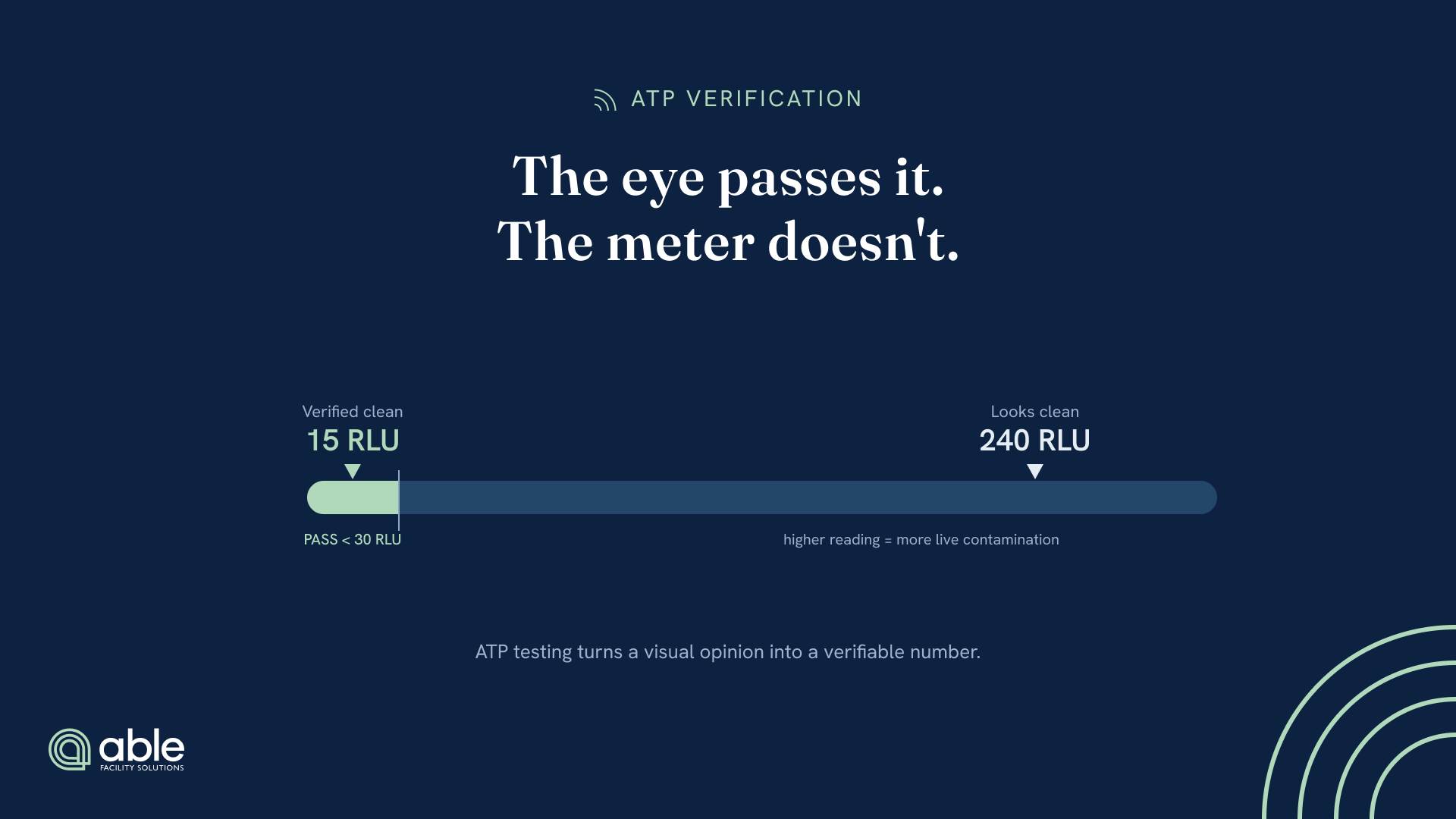
To move beyond guesswork, I suggest implementing ATP bioluminescence testing. This provides objective data on microbial presence. It transforms quality control from a visual opinion into a verifiable metric. Staffing in this environment is a calculation, not a guess.
Regulatory benchmarks: CDC and CMS standards
Compliance is required for facilities that receive Medicare or Medicaid funds. They must follow CMS and CDC guidelines for environmental infection control. High-performing providers manage these complex mandates by utilizing a tiered approach to resource allocation. By developing a comprehensive compliance matrix, facility managers can ensure that no regulatory requirements are overlooked during the procurement and execution of janitorial contracts.
Effective protocols typically include these frequencies:
- Public areas: Daily cleaning with a focus on high-touch points like elevator buttons and door handles.
- Clinical exam rooms: Disinfection of all patient-contact surfaces between every visit.
- Sterile processing areas: Stringent terminal cleaning protocols following every shift.
- Restrooms: Multi-stage disinfection at least twice daily using hospital-grade chemicals.
Terminal cleaning requirements
Terminal cleaning is the most intensive form of medical facility cleaning services. It involves the total decontamination of a room following patient discharge. This process requires moving equipment and cleaning from top to bottom. It ensures every square inch of the environment is treated. I recommend auditing these sessions personally to ensure no corners are cut. Terminal cleaning is your final line of defense against persistent pathogens like C. diff.
Training requirements: OSHA and bloodborne pathogens
Healthcare cleaning staff must be well trained in OSHA rules on bloodborne pathogens and SDS. This helps ensure safety and compliance. However, maintaining these standards at scale requires more than a one-time orientation. Leading organizations improve knowledge retention and consistency. They deliver micro-content for frontline training. This training fits into the daily workflow of cleaning crews.
Personal protective equipment (PPE) compliance
Service quality often declines when PPE habits are poor, because improper use of gloves, gowns, and masks can spread germs between rooms. A vendor that fails to enforce PPE protocols is likely neglecting other critical technical standards. To reduce this risk, facility managers should confirm vendor performance using a strict healthcare cleaning compliance framework. They should review training logs for each person assigned to the site.
Evaluating your vendor: A compliance checklist
Selecting a partner requires verifying documented safety protocols over simple cost-savings. I advise using these five steps to vet your next medical office cleaning service:
- 1Request proof of specialized bloodborne pathogen training for all onsite personnel.
- 2Verify the use of EPA-registered, hospital-grade disinfectants with appropriate dwell time charts.
- 3Audit the vendor's SDS management system to ensure all chemicals are documented and accessible.
- 4Ask for a demonstration of their cross-contamination prevention system, such as color-coded microfiber tools.
- 5Confirm that the vendor uses a W-2 labor model to ensure direct supervision and accountability.
When reviewing potential partners, particularly when looking for commercial cleaning in New Jersey, ensure they prioritize technical disinfection over general janitorial tasks.
The accountability gap: W-2 vs. subcontracted labor
The biggest risk in medical office cleaning is using subcontractors. The 1099 model limits how the main vendor can direct work methods and training. This creates a dangerous accountability gap in environments where precision is non-negotiable. Utilizing W-2 clinical cleaning teams provides the right legal framework for strong oversight. This helps ensure clinical-grade disinfection standards are consistently met by a managed workforce.
Labor model comparison
| Feature | W-2 self-performed model | Subcontracted/1099 model |
|---|---|---|
| Training oversight | Direct and mandatory | Indirect and inconsistent |
| Protocol adherence | High via direct supervision | Variable and hard to verify |
| Background checks | Managed by employer | Often outsourced or bypassed |
| Liability protection | Clear chain of command | Diluted and complex |
Common questions
How often should a medical office be cleaned?
High-touch surfaces in waiting areas and exam rooms should be disinfected multiple times daily. Non-clinical administrative areas typically require daily cleaning. The exact frequency is determined by patient volume and the risk level of the specialty.
Does Medicaid cover cleaning services?
Medicaid does not typically pay for cleaning services directly. However, facilities must maintain specific cleanliness standards to remain eligible for Medicaid and Medicare reimbursements. This makes professional cleaning a critical operational cost.
What everyone should know about medical office cleaning?
The most important factor is that visual cleanliness does not equal biological safety. You should prioritize vendors who use evidence-based disinfection and documented training. Do not choose vendors only because they offer the lowest price.
Selecting the right partner for your medical institution is a matter of patient safety and regulatory survival. I recommend scheduling a comprehensive facility walkthrough to identify current gaps in your disinfection program. A technical analysis of your institution's cleaning standards can reveal hidden liabilities before they become clinical failures. Book a call with Able Facility Solutions today. Get a free audit checklist and a 30-day guarantee on service transitions.