
Is your cleaning crew stretched thin or overstaffed? Most facility managers rely on guesswork, which often leads to poor hygiene standards or unnecessary labor spend. The math behind accurate janitorial staffing ratios is a technical calculation based on industry-standard production rates. If you ignore your floor plan details, you may overpay for idle labor or risk asset protection.
The short answer
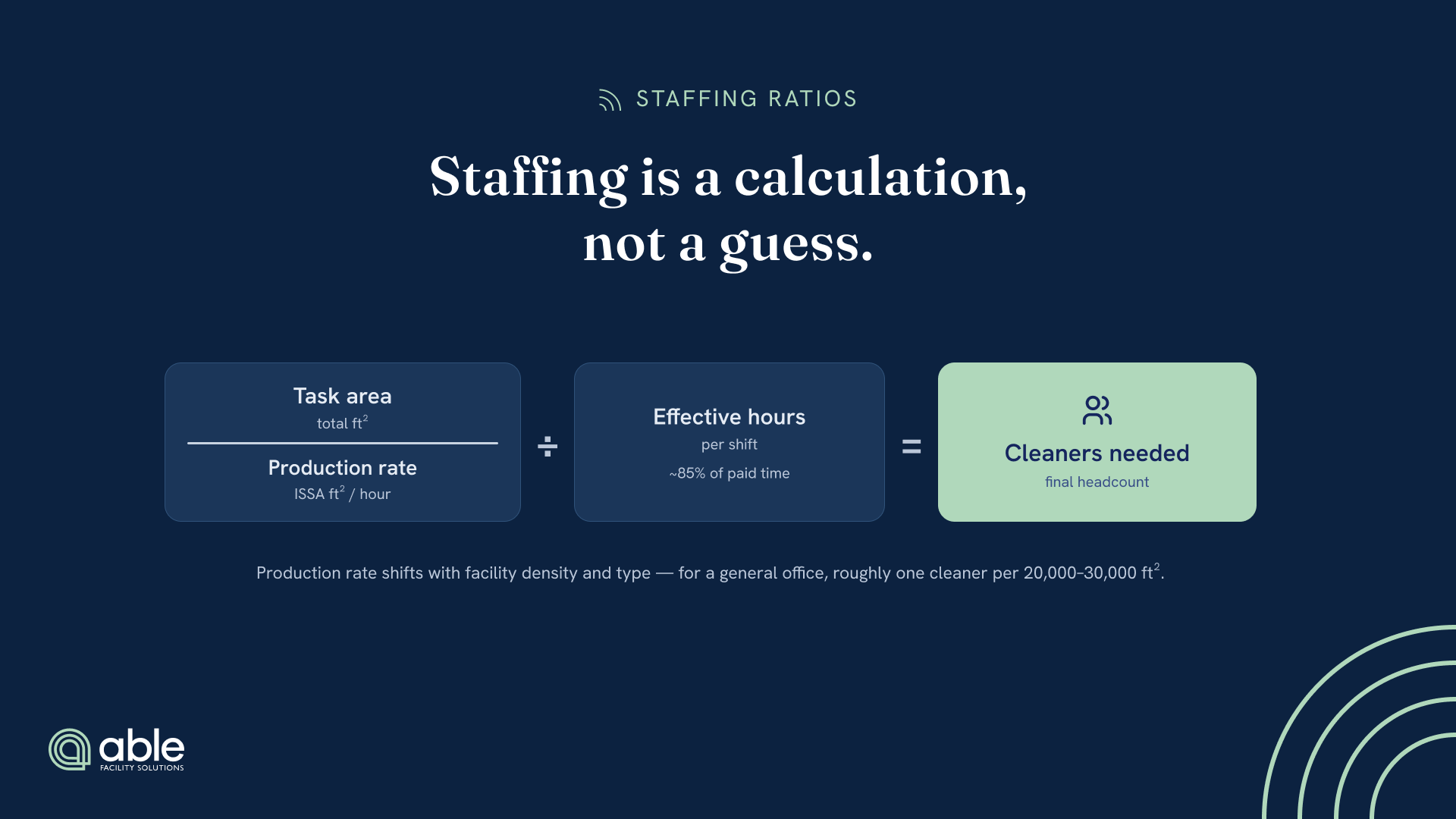
Professional staffing is calculated by dividing the total square footage of specific task areas by industry-standard production rates. You then adjust for facility density, effective labor hours, and non-cleaning tasks to reach a final headcount. For most commercial offices, this results in one cleaner for every 20,000 to 30,000 square feet of general workspace.
Using ISSA standards for janitorial staffing ratios
To build an accurate budget, you must start with recognized benchmarks rather than anecdotal estimates. The International Sanitary Supply Association (ISSA) provides the most reliable foundation for these calculations. These standards state how many minutes it takes to do specific tasks. Examples include vacuuming 1,000 square feet of carpet. Another example is disinfecting a restroom stall.
Herbert Hoover, before his presidency, was a mining engineer who spent decades on the principle that every operational decision should be traceable to a specific measurable calculation. He said it plainly:
“"Every time we find a way to increase output for a given input, we increase our national wealth." - Herbert Hoover”
When you apply these standards, you realize that square footage is only half the story. A 50,000 square foot warehouse needs far fewer hours than a 50,000 square foot corporate office. The office may have hundreds of cubicles and many high-touch surfaces. You can use a technical janitorial RFP framework to identify daily requirements versus weekly deep cleans. This detail ensures your labor model reflects actual operational needs.
Why facility density and type change the ratio
High-traffic environments like medical clinics require more frequent disinfection and specialized waste handling compared to low-density spaces. This is where many facility managers fail to account for the density factor. A dense floor plan increases the count of obstacles a cleaner must navigate, which naturally slows down cleaning times per square foot.
Ellen Kullman, the former DuPont CEO whose operational discipline reshaped one of America's oldest industrial companies, framed the case for density-aware planning as clearly as anyone:
“"You cannot manage growth without measuring it." - Ellen Kullman, former CEO of DuPont”
Medical facility cleaning services, for instance, demand a much lower ratio because of the high frequency of touchpoint disinfection required by regulatory standards. In contrast, a low-density logistics center can produce more. It has open floor plans. It also has fewer vertical surfaces.
Impact of facility environment
- Medical facilities: Requires high-frequency disinfection, strict compliance, and specialized medical facility cleaning services waste disposal.
- Corporate offices: Focuses on high-touch points, common area aesthetics, and restroom hygiene.
- Educational centers: Demands high-volume floor care and specialized restroom protocols for high-occupancy counts.
- Industrial plants: Requires heavy-duty equipment, safety-focused task paths, and specialized floor scrubbers.
Accounting for effective labor hours and utilization
Total shift time is never equal to total cleaning time. Effective labor hours are typically 10 to 15% lower than the total paid shift. This loss occurs because of mandatory breaks, equipment setup, and travel time between zones. If you schedule eight hours of cleaning tasks for an eight-hour shift, the work will remain unfinished.
Henry Mintzberg, the McGill University management theorist whose research on the gap between planned and realized work shaped how modern operations think about scheduling, said it in a line every facility director should read before their next shift design:
“"Managers who cannot manage their own time cannot manage anything else." - Henry Mintzberg, McGill University”
This gap mirrors the producer-level benchmarks seen in other labor-intensive industries, where structural loss is inevitable. You should also consider the office cleaning frequency by facility type. This helps you decide if you need night shifts or day porter services.
| Facility Type | Square Feet Per Hour (Avg) | Staffing Density |
|---|---|---|
| General Office | 3,000 – 4,000 | Medium |
| Medical Clinic | 1,500 – 2,500 | High |
| Warehouse | 10,000 – 15,000 | Low |
| Educational | 2,500 – 3,500 | High |
Addressing the total cost of facility management staffing
When calculating your staffing needs, you must account for the full labor burden. This includes the commercial cleaning rates in NYC or your region. These rates reflect local labor laws and building logistics.
A janitorial staffing agency usually handles recruiting and training tasks. You must confirm they use W-2 employees to maintain accountability. If your facility needs specialized care, like a one-time post-construction cleaning, plan for it separately. Add it as its own line item in your budget. If you need a glass cleaner for high-rise facades, budget that separately too. Do not include these costs in the daily ratio.
In facility management, the ratio is only a starting point. The real efficiency comes from matching the right production rate to the specific density of the environment. : Able Facility Solutions
Common questions
What are standard janitorial staffing ratios?
Standard ratios range from one cleaner per 20,000 square feet in busy offices. In open warehouses, ratios range up to one cleaner per 100,000 square feet. The correct ratio depends on the cleaning quality level required and the density of the space.
How does facility type affect cleaning times per square foot?
Facility type determines the production rate. For example, a medical facility cleaning program needs more time per square foot due to disinfection rules. A warehouse can be cleaned faster using automated floor scrubbers.
Should I use a janitorial staffing agency or in-house staff?
A janitorial staffing agency or specialized janitorial staffing services provider typically offers better scalability and absorbs the costs of turnover and training. This allows facility management staffing to remain flexible based on seasonal needs.
How do I handle specialized cleaning tasks?
Tasks like using a glass stove top cleaner, glasses cleaner, or Sprayway glass cleaner should be periodic tasks. Use it for architectural glass. These are often best handled by a one-time cleaning service, like Go Time Cleaning and Restoration LLC. The daily crew may not be the best fit.
Audit your current square footage and task list against ISSA cleaning standards. If your current crew is missing benchmarks, it may be time to re-evaluate your labor model. Contact us for a full facility staffing analysis.