
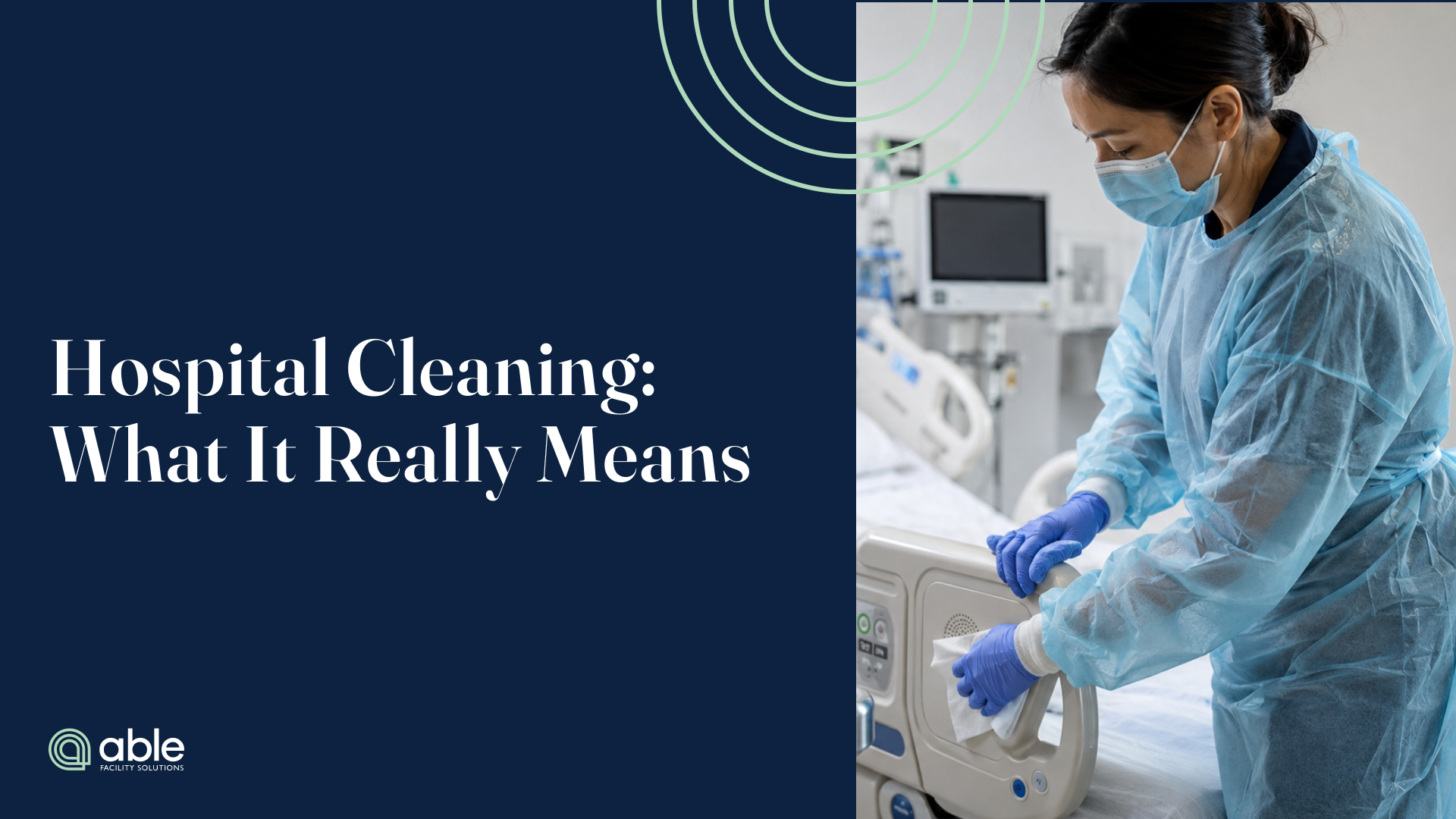
In a clinical setting, the gap between visibly clean and truly disinfected affects patient safety and compliance risk. Most commercial cleaning services operate on a residential-plus model that fails the rigorous standards of healthcare. Professional healthcare-grade cleaning protocols provide the technical foundation for facility compliance and facilities management.
The short answer
Medical facility cleaning requires a transition from visual tidiness to clinical disinfection. Meeting this standard requires EPA-registered disinfectants and strict compliance with manufacturer dwell times. It also requires a W-2 workforce to ensure accountability and specialized training for patient safety and compliance. Regular janitorial services often lack the documented audit trails required for healthcare audits. Many providers seek guidance on how to get janitorial contracts for these specialized environments.
Defining the healthcare standard
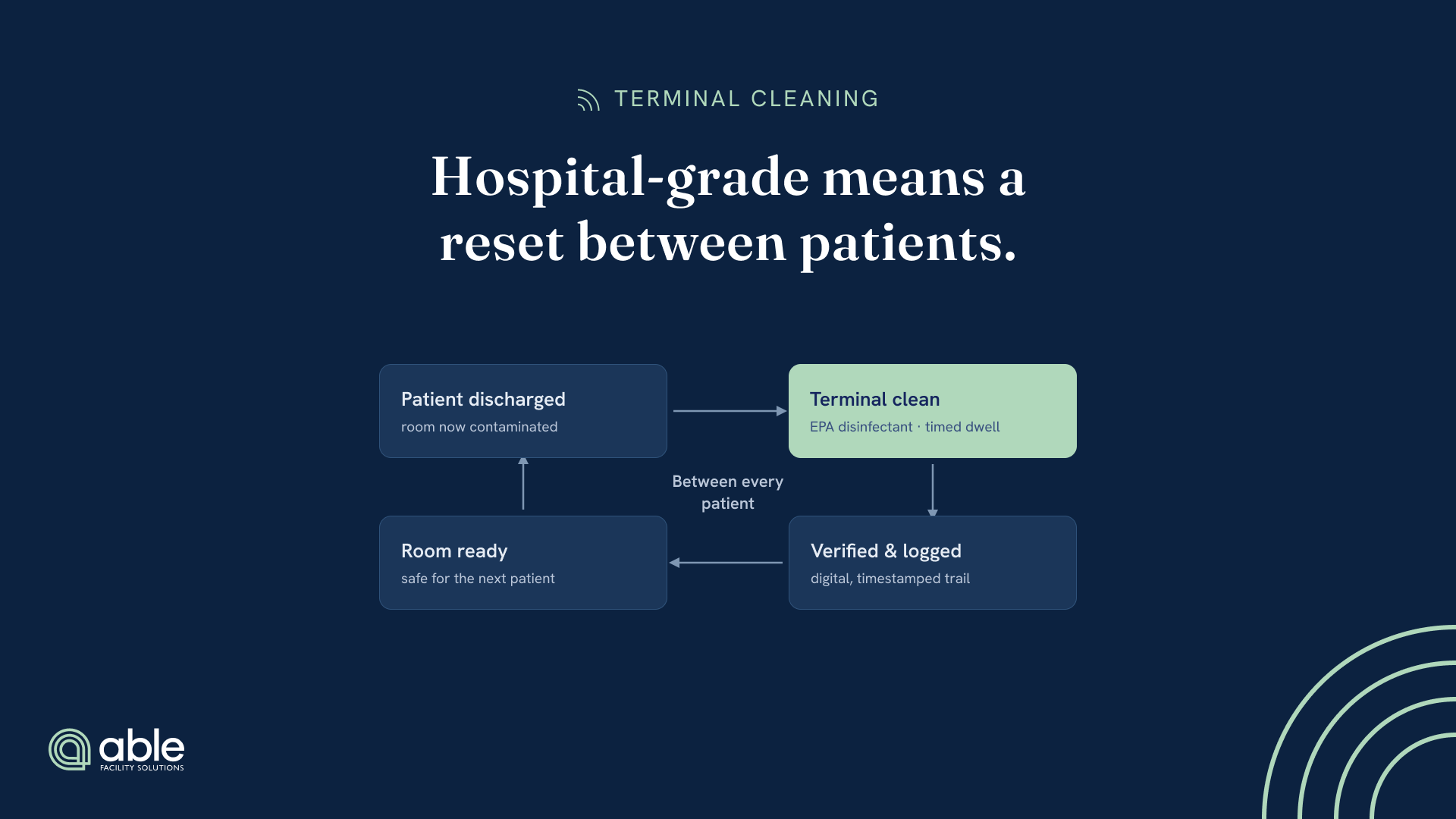
Hospital-grade cleaning involves the systematic use of EPA-registered disinfectants and technical training that exceeds standard janitorial scopes. It requires a documented approach to terminal cleaning. Rooms must be fully disinfected between patients. Staff must follow manufacturer-specified dwell times. For a medical facility in California, these standards require a W-2 workforce to ensure direct accountability. In these environments, hospital cleaning is measured by clinical outcomes rather than visual tidiness.
Professor Didier Pittet, the hospital epidemiologist who directs the WHO Collaborating Centre on Patient Safety at University of Geneva Hospitals and chairs the Clean Hospitals initiative, draws the distinction in a single line:
“"Cleaning a hospital is not cleaning a hotel."”
Professor Didier Pittet, University of Geneva Hospitals; chair, Clean Hospitals — Infection Control Today, 2022
The gap between clean and disinfected
Standard janitorial cleaning contracts often use a spray-and-wipe method. This can ignore the needed dwell time to kill germs. In a healthcare setting, every high-touch surface must stay wet. Use a hospital-grade disinfectant for the full time listed by the manufacturer. Modern protocols for hospital cleaning services focus on high-touch hotspots to prevent healthcare-associated infections. According to the Centers for Disease Control and Prevention, these infections represent a significant risk to patient health.
This is the distinction the research literature keeps returning to. Dr. William Rutala and Dr. David Weber of the University of North Carolina, among the most widely cited authorities on healthcare surface disinfection, put it directly:
“"Effective disinfection requires not only an effective product but also, effective practice."”
Dr. William A. Rutala and Dr. David J. Weber, University of North Carolina -Infection Control Today
Environmental contamination plays a significant role in the transmission of several key healthcare pathogens (National Institutes of Health). This makes the distinction between looking clean and being disinfected a matter of infection control. Our expertise also extends to hospitality cleaning and manufacturing facility cleaning for diverse industrial needs.
| Service component | Standard janitorial | Hospital-grade cleaning |
|---|---|---|
| Disinfectant | General purpose | EPA-registered (Grade 2) |
| Dwell times | Rarely observed | Strictly documented |
| Labor model | Often 1099/subcontracted | W-2 self-performed |
| Audit trail | Visual inspection | Digital task verification |
Terminal cleaning compliance requirements
Proper terminal cleaning is a technical requirement for patient safety and audit readiness. This process involves the total disinfection of a room between patients to prevent cross-contamination. Our protocols are as rigorous as data center cleaning standards.
- Directional cleaning: Teams move from clean to dirty areas to ensure pathogens do not spread.
- Dwell time verification: Ensuring surfaces stay wet for the full 3 to 10 minutes required by the disinfectant.
- Waste handling: Adhering to protocols for hazardous waste and sharps disposal.
- Quality audits: Documented inspections prove every corner has been addressed.
- Digital verification: Using technology to track task completion and timestamped cleaning logs.
The infection prevention community treats this documentation as central rather than administrative. As Dr. Tania Bubb, 2024 president of the Association for Professionals in Infection Control and Epidemiology, has noted:
“"Effective disinfection protocols are essential for successful infection prevention and control in healthcare settings."”
Dr. Tania Bubb, 2024 President, Association for Professionals in Infection Control and Epidemiology - APIC, 2025
Facility managers must be prepared for unexpected inspections. If a cleaning crew cannot provide a digital trail of task completion, the facility is at risk. From medical office cleaning to surgical suite maintenance, using direct W-2 staff ensures workers are trained in healthcare protocols.
The W-2 accountability advantage
Subcontracted 1099 models often fail to meet technical standards for medical-grade environments because they lack direct oversight. A W-2 workforce provides the discipline required for high-stakes compliance. When workers use a self-performed model, they are more likely to follow strict rules. They are more likely to follow infection prevention protocols. They are more likely to follow hazardous waste rules. Having day porter services on-site helps keep busy common areas clean and sanitized all day.
How to compare medical cleaning providers
- 1Verify W-2 status: Confirm the cleaners are direct employees, not 1099 subcontractors. This is the foundation of our accountability model.
- 2Check the EPA list: Ensure all disinfectants used are hospital-grade and registered for clinical use.
- 3Review training logs: Ask for documentation of specific terminal cleaning training.
- 4Audit the technology: Confirm the vendor uses a digital system to track dwell times and task completion. It should be like the verification tools we use on-site.
Frequently asked questions
What is commercial cleaning in healthcare?
It is the systematic disinfection of clinical environments using hospital-grade disinfectants and terminal cleaning protocols. Professional healthcare cleaning services focus on eliminating pathogens and reducing the risk of healthcare-associated infections through documented, technical labor.
How are commercial cleaning rates for medical sites calculated?
Rates depend on zone risk levels, required air exchange rules, and the disinfectant dwell times needed. Specialized cleaning contracts for medical sites reflect the specialized training and higher labor density required for compliance.
What does terminal cleaning involve?
Terminal cleaning is the process of disinfecting a patient room in its entirety between occupants. It involves cleaning from top to bottom, and from clean areas to dirty areas. This ensures all high-touch surfaces are treated for the correct dwell time.This helps prevent cross-contamination. Consistency in hospital cleaning is built on documented standards.
We invite you to book a call with our team at Able Facility Solutions. This will help verify your current compliance levels.