
For decades, many facility managers believed that if a cleaner didn't smell like a chemistry lab, it wasn't actually working.
Rachel Carson made the case against exactly that instinct in 1962. Chemical decisions that feel small, she argued, are rarely small in their effect. It was ironic, she wrote, that a future might be determined by:
“"...something so seemingly trivial as the choice of an insect spray."”
Rachel Carson — *Silent Spring*, 1962
For property managers in the Tri-State area, this misconception can cause problems. It can hurt indoor air quality. It can also shorten the building’s lifespan, especially in busy retail centers or office buildings. Relying on harsh bleach and ammonia-based cleaners can harm occupant health and the building envelope. Modern maintenance plans protect the building and the people inside. That is why many organizations now use professional commercial cleaning services.
The short answer
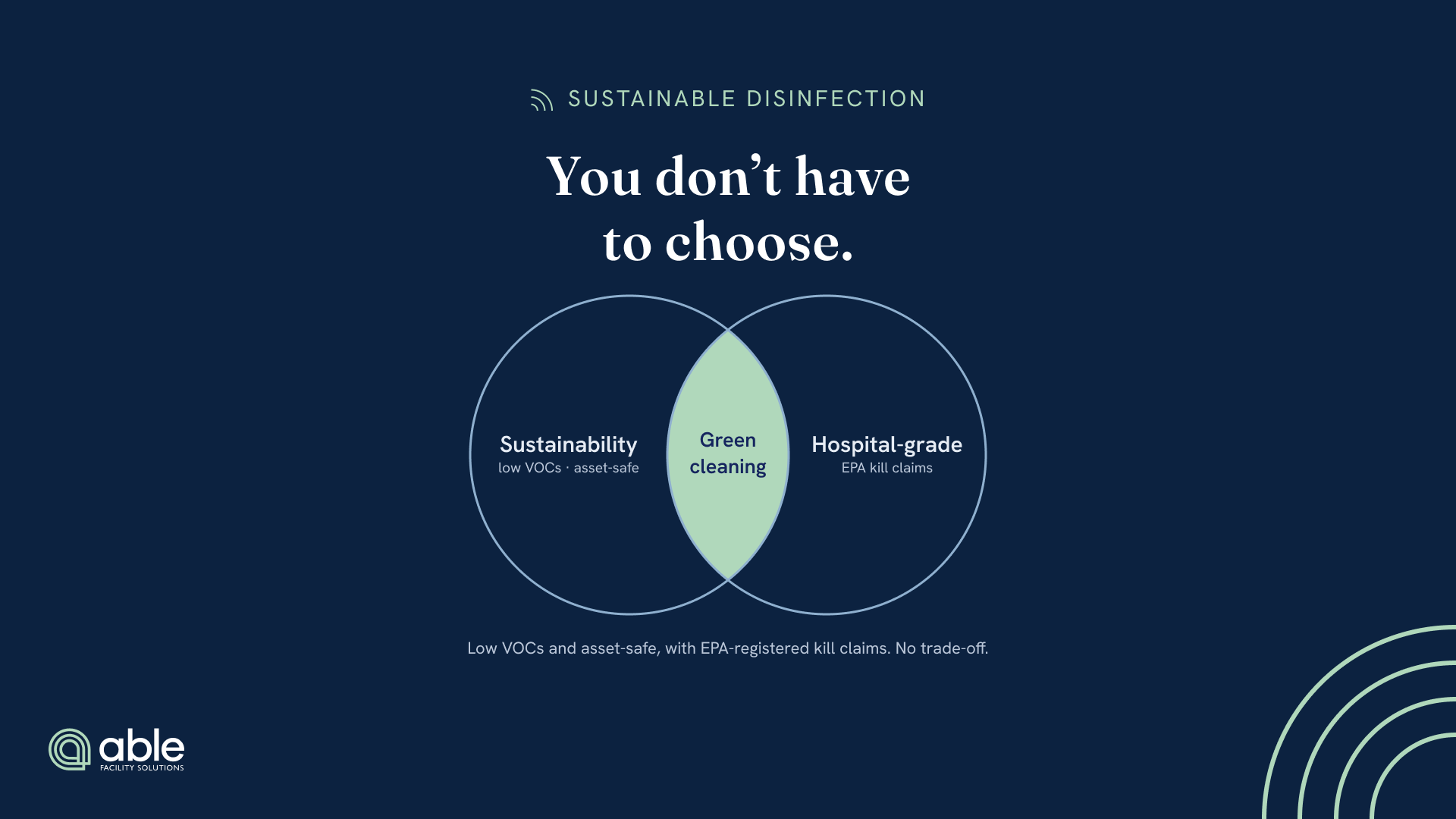
Facility optimization requires a shift to sustainable cleaning programs that prioritize low VOC emissions without sacrificing pathogen kill rates. Modern green chemicals, used by trained W-2 workers, clean as well as industrial products and protect costly facility assets. This shift improves respiratory health for occupants and lowers the facility’s total cost of ownership. It is backed by a 30-day service quality guarantee.
The VOC problem: why commercial cleaning services matter
High Volatile Organic Compound (VOC) levels in commercial offices and retail clinics lead to significant respiratory health issues. When you use harsh industrial chemicals, you are essentially trading one risk for another. The strong odor of traditional cleaners is a sign of off-gassing. This can irritate the lungs of employees and shoppers, leading to decreased comfort and negative brand impressions. Technical strategies like touchpoint disinfection programs help manage viral loads during flu season without over-relying on high-VOC deep cleans. Choosing a high-quality commercial cleaning company ensures that these technical strategies are executed with safety-first products.
There is also the hidden cost of surface corrosion. Harsh chemicals accelerate the degradation of expensive facility assets. Green disinfection serves as a key asset preservation strategy. By using pH-neutral, sustainable alternatives, you extend the life of your VCT flooring and specialized commercial surfaces. This preservation leads to a measurable increase in ROI by delaying capital expenditure on floor replacements. Integrating these practices into your facility management services is vital for long-term building health. Many commercial cleaning businesses now prioritize green chemistry.
Green vs. industrial: the disinfection calculation
Chemical performance comparison
| Feature | Traditional industrial cleaner | Green-certified alternative |
|---|---|---|
| Kill claims | Broad spectrum | Broad spectrum |
| Dwell times | 5-10 Minutes | 3-5 Minutes |
| Air quality impact | High VOCs / irritants | Low VOCs / neutral |
| Surface impact | Corrosive / abrasive | Non-corrosive / gentle |
Why dwell time is the real metric of success
Proper disinfection is not about the strength of the smell. It is about the science of contact. Subcontracted labor often skips critical steps to meet unrealistic production rates. Utilizing a directly employed workforce ensures these ISSA standards are met for all janitorial cleaning services:
- Thorough soil removal before disinfectant application.
- Precise chemical dilution ratios for maximum efficacy.
- Continuous surface wetness for the full manufacturer-recommended dwell time.
- Use of color-coded microfiber to prevent cross-contamination.
Understanding the technical hierarchy of disinfection is essential for ensuring facility safety. For high-traffic areas, add electrostatic disinfection or commercial disinfection services. They provide better coverage for complex surfaces when paired with manual cleaning. These protocols ensure that sustainability does not compromise safety.
FAQ
What is a green cleaning program?
A green cleaning program uses chemicals and equipment designed to reduce environmental impact and improve indoor air quality. I recommend choosing products certified by Green Seal or CIMS-GB to confirm they meet safety and performance standards. Implementing effective commercial cleaning protocols requires a balance of safety and efficacy.
Can green cleaners kill viruses as effectively as bleach?
Yes. Modern green disinfectants have EPA-registered kill claims that match industrial cleaners. Success depends on the technician following the required dwell time for the specific pathogen they are targeting.
How does sustainable cleaning impact facility ROI?
Sustainable cleaning reduces the use of corrosive chemicals that strip floor finish and damage expensive retail fixtures. This asset preservation strategy extends the lifecycle of VCT and other high-value surfaces, reducing long-term maintenance costs.
Implementing a sustainable facility plan
- 1Audit your current chemical closet to identify high-toxicity products using a compliance checklist.
- 2Transition to Green Seal or CIMS-GB certified chemicals to ensure performance standards.
- 3Train your staff on the specific application protocols required for sustainable products.
Maintaining commercial safety while going green requires choosing specialized cleaning partners who prioritize W-2 labor and OSHA compliance.
Ready to improve your indoor air quality and protect your building assets? Schedule your facility audit with Able Facility Solutions today.