
When a municipal cleaning contract fails, the result is a public audit and a security breach. For government contracting officers, the lowest bid can bring the highest risk. Public facilities need clear, documented accountability. Traditional subcontracting models often cannot provide it. Ensuring reliable Government Facility Cleaning Services means moving past the lowest-price-technically-acceptable (LPTA) mindset. It calls for a model based on transparency and direct control of labor.
The short answer
Successful government facility management relies on strict manpower ratios, verified W-2 janitorial workforce staffing, and performance metrics that survive public scrutiny. Direct employment eliminates the liability gaps and background check inconsistencies inherent in subcontracted janitorial models.
Public fund accountability and manpower ratios
Municipal contracts mandate standardized manpower ratios to justify the use of public funds. Contracting officers must see exactly how many hours are billed versus how many are worked on-site. This transparency is easier to achieve when you use a technical cleaning scope of work. It defines production rates and labor expectations. Without these benchmarks, you cannot audit the value of the service provided to the taxpayer.
Effective Government Facility Cleaning Services also require specialized care for high-traffic public areas. For example, keeping civic buildings looking professional needs close attention to detail. Use a professional glass cleaner and high-grade products like Sprayway Glass Cleaner. This helps keep lobbies and glass partitions clean. Consistent use of a high-quality glasses cleaner or glass stovetop cleaner keeps breakroom surfaces clean. It helps every surface meet public office standards.
The risk of a janitorial staffing agency model
Subcontracting creates liability gaps and oversight failures that threaten municipal cleaning compliance. When a vendor works as a third-party janitorial staffing agency, the contracting officer cannot see the labor pool. The contracting officer has less insight into who is available to do the work. This often leads to staffing shortages or the use of unvetted personnel, which can trigger safety violations.
Cesar Chavez, the labor leader whose organizing work rebuilt how American institutions think about direct employment and worker accountability, gave us the principle that underlies every W-2 argument:
“"The end of all education should surely be service to others." - Cesar Chavez”
For medical facility cleaning services within public health departments, this risk is even higher. Consistency is only possible when the vendor has direct control over training and scheduling. Using W-2 labor as a risk management tool makes sure each person on-site is a direct employee. Each employee is fully insured and vetted.
- Direct Background Checks: Every cleaner is vetted directly by the prime contractor.
- Training Standards: Uniform protocols across all municipal sites.
- Liability Coverage: No fragmented insurance certificates between tiers of subcontractors.
- Regulatory Compliance: Simplified reporting for go time cleaning and restoration llc or similar emergency response scenarios.
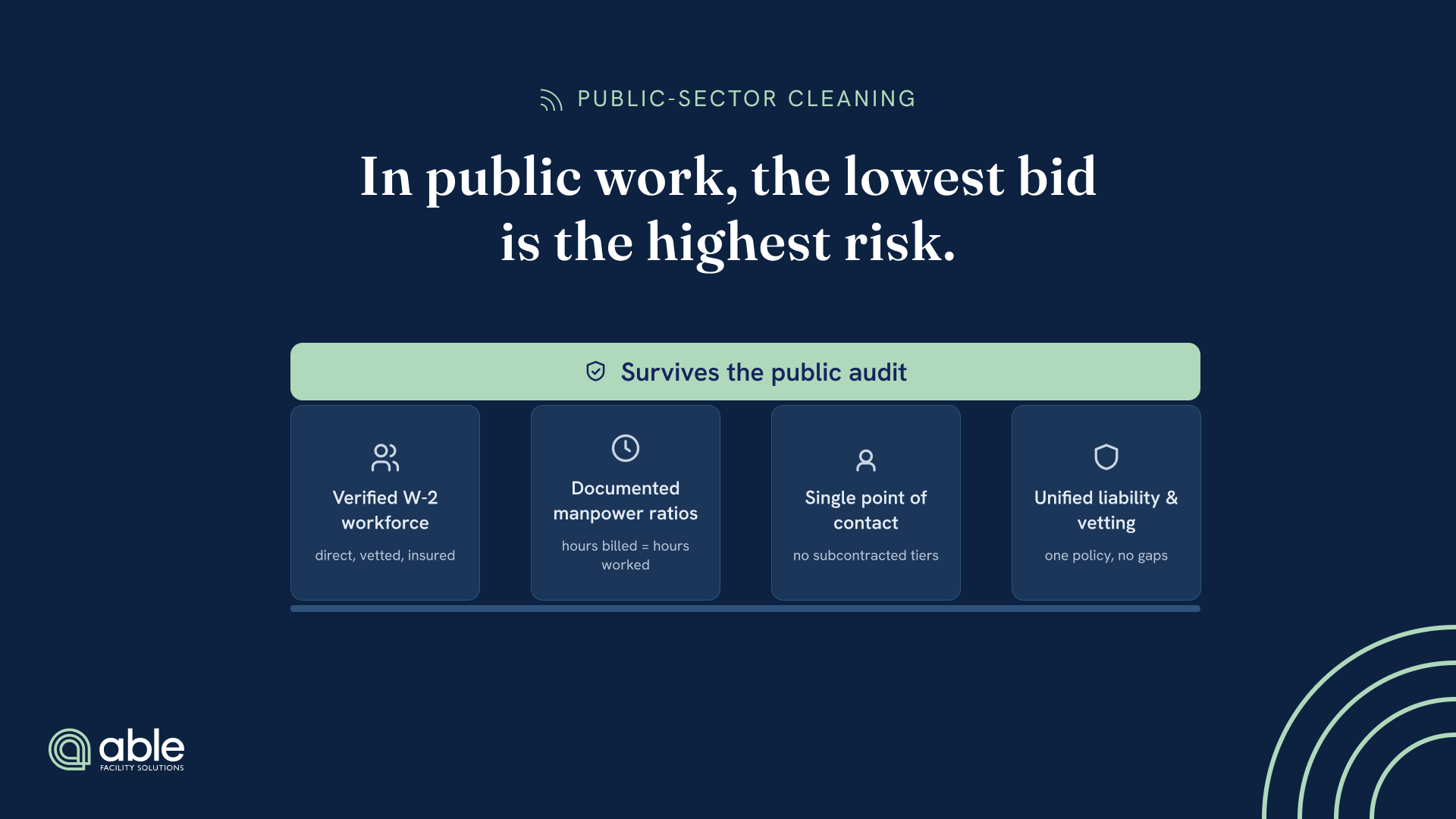
Comparison of labor models in public facilities
| Compliance Factor | W-2 Self-Performed | Subcontracted (1099) |
|---|---|---|
| Background Checks | Direct & Documented | Variable & Third-party |
| Liability Coverage | Unified Policy | Often Fragmented |
| Training Standards | Uniform | Inconsistent |
| Accountability | Single Point of Contact | Complex Multi-tier |
Common questions
How do we ensure compliance with prevailing wage laws?
A self-performed model gives payroll transparency to prove compliance with local prevailing wage rules during an audit. This is a common requirement for any reputable janitorial staffing agency or direct service provider working with municipal funds.
What are the risks of using unvetted 1099 contractors?
Using unvetted labor increases the risk of security breaches and insurance denials. A medical facility cleaning services provider using a W-2 model ensures staff are trained. They follow clinical protocols that 1099 contractors often lack.
Can we request a one time cleaning service for public events?
Yes, municipal contracts should include a one-time cleaning service provision. It should cover public forums, elections, or emergency restoration needs. This helps avoid disrupting daily maintenance. It is important to ensure your partner has the scale to provide a one time cleaning service on short notice.
Barbara Jordan, the congresswoman whose voice on public integrity during the Watergate hearings became the standard for institutional accountability, said it in a line every contracting officer should paste into their evaluation criteria:
“"What the people want is very simple. They want an America as good as its promise." - Barbara Jordan”
Ready to audit your current cleaning vendor for labor transparency? Book a call with Able Facility Solutions today for a full municipal compliance review.