
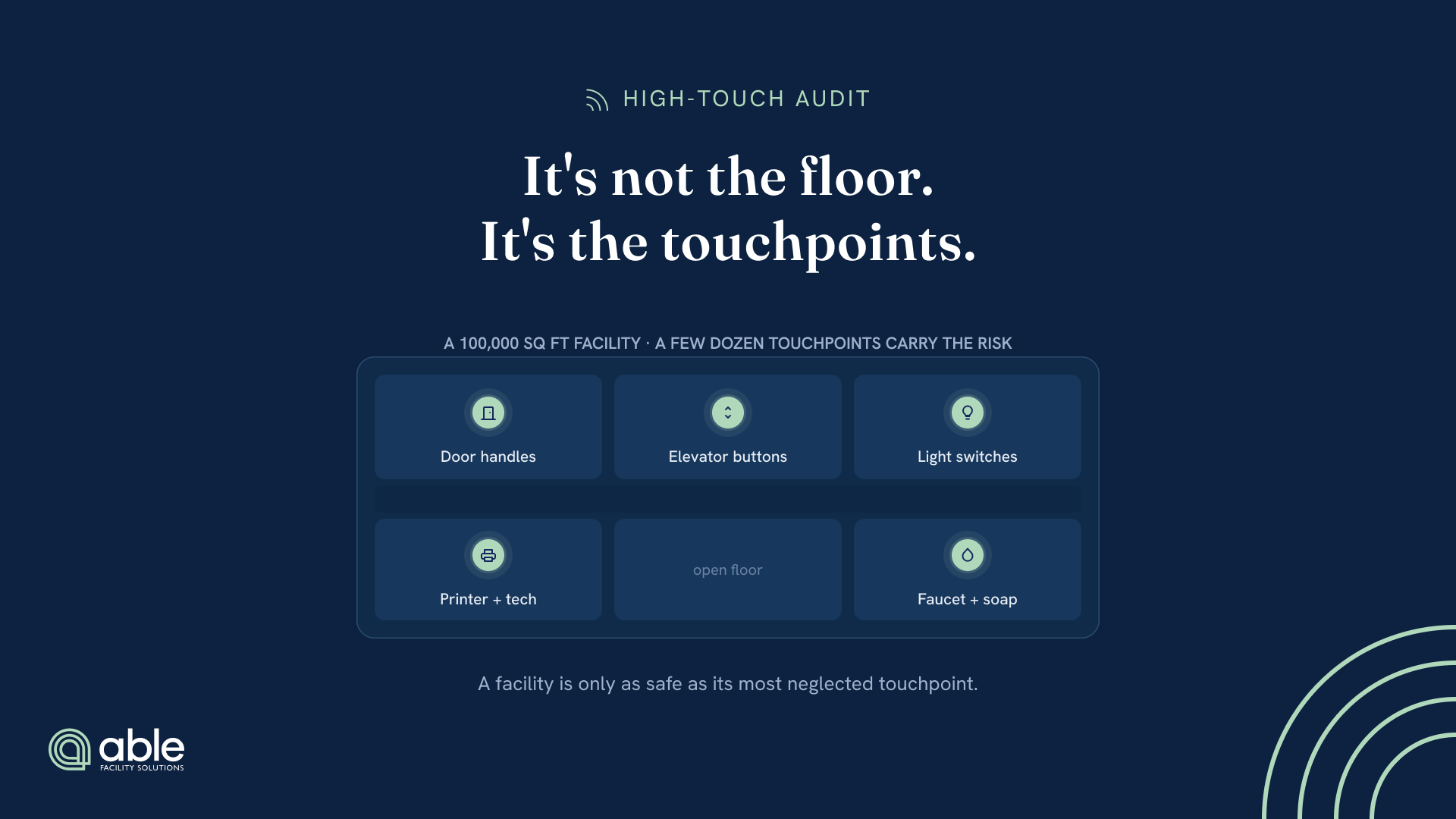
In a 100,000 square foot retail center or commercial office building, wide open hallways rarely cause an inspection failure. I have found that the real risk lies in the three dozen door handles and elevator buttons that many touch but few clean. Many comprehensive cleaning protocols rely on a visual standard, which I recommend property managers avoid. This approach is dangerous because a facility is only as safe as its most neglected touchpoint. Able Facility Solutions defines success by disinfecting high-touch surfaces rather than visual aesthetics.
The short answer
A daily facility housekeeping checklist must prioritize high-touch surface disinfection and ISSA production rates over visual aesthetics. I recommend using self-performed W-2 labor to ensure strict adherence to chemical dwell times and technical standards. This shifts cleaning from a subjective task to a calculated risk mitigation tool that protects the building's ROI.
Why commercial cleaning services matter
A modern institutional audit requires three components: high-frequency touchpoint prioritization, standardized ISSA production rates, and direct W-2 accountability. This shifts cleaning from a subjective task to a risk mitigation tool. It protects the building's long term ROI and brand standards. Many organizations work with a specialized cleaning company to keep these technical standards consistent in NJ, NY, and Philadelphia.
The high-traffic touchpoint audit
Identifying critical zones
Effective daily checklists prioritize areas where pathogens spread fastest. I recommend focusing on the specific items that occupants contact throughout the day. These include:
- Door handles, latch plates, and ADA push plates
- Elevator call buttons and interior control panels
- Light switches in common areas and conference rooms
- Faucet handles and soap dispenser levers in restrooms
- Shared technology like printer touchscreens and breakroom appliance handles
Dwell time requirements
Spraying a surface is ineffective if it is wiped off immediately. Many crews fail because they ignore disinfection protocols. A checklist must require that disinfectants remain wet for the full period recommended by the manufacturer. This dwell time is a non-negotiable metric for clinical level safety. Managing this requires professional janitorial services that train staff on chemical contact times.
Production rates: the math behind the checklist
Labor use analysis across massive buildings shows that quality drops when staffing is insufficient. I have found that using ISSA production rates ensures that janitorial staffing ratios are properly scoped. These metrics should be adjusted based on specific office cleaning frequency requirements to avoid gaps. Professional facility management services help calculate these labor allocations to maintain safety.
Labor production and quality metrics
| Facility protocol | Cleaning time (Per 1,000 sq. ft.) | Quality level |
|---|---|---|
| Standard aesthetic | 15-20 Minutes | Visual only |
| High-disinfection | 35-45 Minutes | Bio-safe |
| Post-pandemic baseline | 30 Minutes | Clinical standard |
The W-2 workforce advantage in auditing
Using a labor model that brokers staff makes the checklist a suggestion. Subcontractors are often paid by the job, which encourages speed over safety. Self-performing W-2 teams at a dedicated commercial cleaning company are the only reliable way. They ensure 100% completion of industrial cleaning tasks. Direct employment allows for real time performance monitoring and strict adherence to safety standards during complex cleaning operations. Able Facility Solutions backs this accountability with a 30-day guarantee.
FAQ
What is a high-traffic touchpoint?
A high-traffic touchpoint is any surface contacted by multiple individuals daily, such as ADA plates and elevator buttons. These require higher disinfection frequencies than general surfaces.
How are ISSA production rates calculated?
ISSA production rates are standardized time measurements for specific cleaning tasks per square foot. They allow facility managers to calculate the exact labor needed to maintain specific cleanliness levels.
Why does dwell time matter for facility safety?
Dwell time is the amount of time a disinfectant must remain wet on a surface to kill pathogens. If wiped away too early, the chemical fails to mitigate the risk of cross contamination.
Implementing your daily audit
- 1Map every high-traffic touchpoint in your building and add them to your daily scope. Pay attention to how restroom cleaning schedules align with foot traffic.
- 2Calculate staffing needs based on ISSA standards rather than low bid estimates.
- 3Use a technical facility cleaning audit to verify that every checklist item is completed daily.
Modernizing your audit is the first step toward a safer facility. Book a call with us today to schedule a facility walk-through and audit your current labor production rates.