

A generic cleaning checklist is the fastest way to lose control of a multi-site portfolio. In my experience, "one-size-fits-all" is just another term for "unaccountable." When I walk through regional medical groups or school districts, I often see the same failure pattern. A strict contract treats a busy lobby the same as a rarely used storage wing. This wastes budget. It can also cause visible surface damage over time.
W. Ross Ashby, the British psychiatrist and one of the founders of cybernetics, put this failure pattern into a law in 1956. A system can only be kept under control by a regulator with at least as much variety as the system itself. His shorthand for it:
“"Only variety can destroy variety."”
W. Ross Ashby — *An Introduction to Cybernetics*, 1956
Defining the accountability gap
The accountability gap occurs when a janitorial contract is too stiff to meet site-specific needs. In a multi-site portfolio, missing one task in a busy area can cause substrate failure or damage VCT. Choosing a specialized school cleaning company helps keep busy hallways and classrooms clean. Success depends on setting an office cleaning frequency that matches each building’s foot traffic and headcount. Traditional contracts often use 1099 subcontractors who may not have training for complex, custom requirements. This can lead to inconsistent work across your locations.
The ROI of bespoke scoping
Customized scoping is a financial strategy. I help facility managers shift hours from low-impact areas to high-traffic zones. I do this by reviewing foot traffic and surface needs. This prevents expensive, capital-heavy replacements of flooring and fixtures. Investing in a custom facility cleaning plan acts as an insurance policy for physical assets. For organizations managing tight margins, using a budgeting framework ensures cleaning costs align with overall fiscal health.
Case study 1: The specialized museum challenge
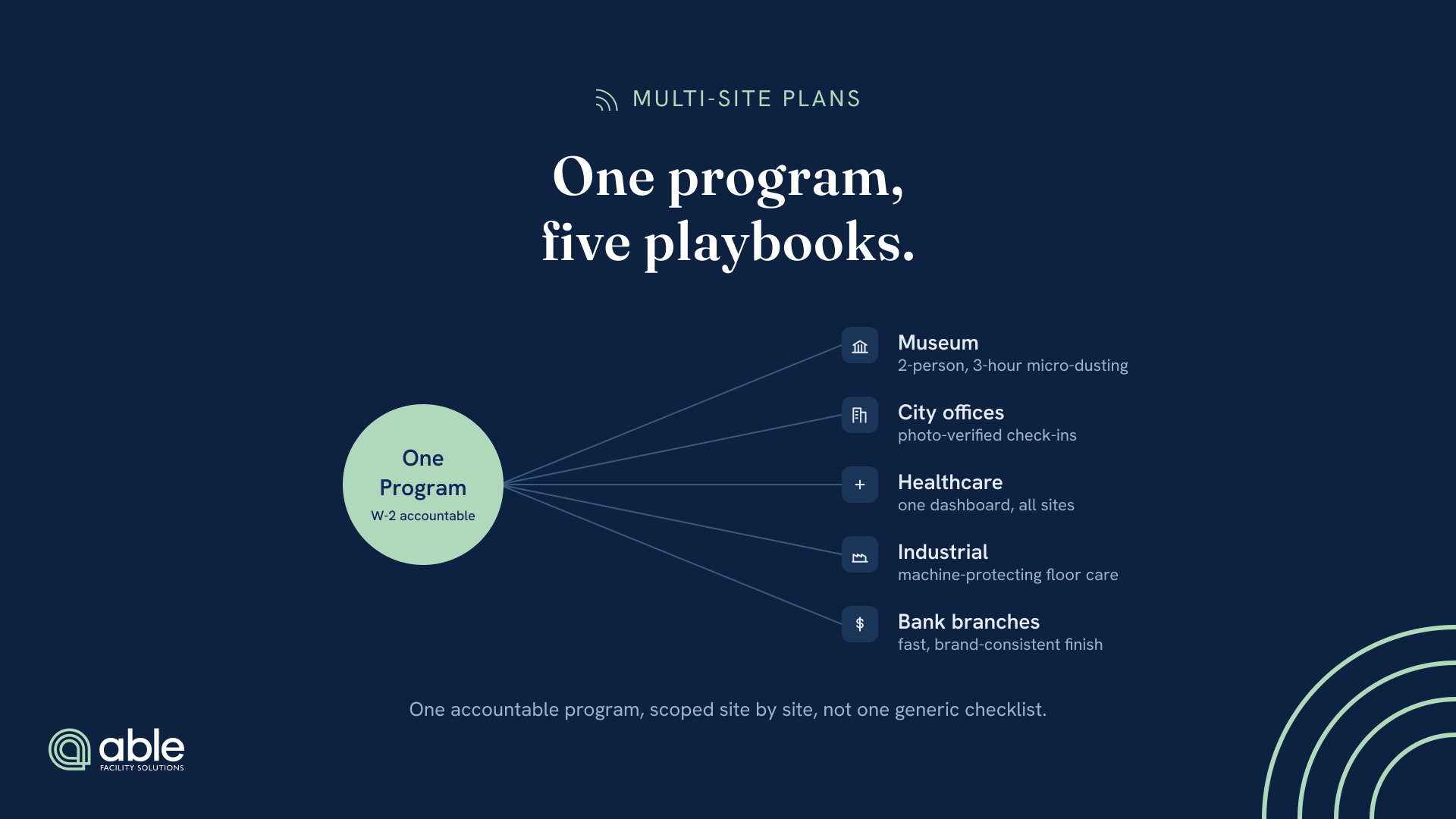
In a recent project for a museum, a generic contract was failing to protect sensitive displays. I implemented a plan that used a custom two-person crew for exactly three hours nightly. This focused approach ensured special exhibits received technical care without forcing the client to pay for a full shift. For those managing campuses, hiring professional cleaning companies for schools involves similar attention to specialized environments like labs or auditoriums.
The switch to a targeted crew helped the client keep museum-grade standards and cut monthly spending by 15%. Nightly needs for this site included micro-dusting of uncased artifacts and careful moisture control for nearby floor surfaces.
Case study 2: Digital verification in municipalities
For a city client managing several office buildings, service complaints were high. We introduced facial-recognition check-ins and required photo uploads for finished tasks. This level of transparency reduced service complaints by 40% almost immediately. When cleaners know their work is digitally checked, quality improves. This works best when frontline employee training uses scalable micro-content. It helps every worker understand digital benchmarks and performance metrics.
Verification performance comparison
| Metric | Traditional reporting | Real-time verification |
|---|---|---|
| Inspection scores | 78% average | 97%+ average |
| Complaint resolution | 48 to 72 hours | Under 4 hours |
| Compliance proof | Paper logs (unverified) | Photo evidence (timestamped) |
Case study 3: Digital compliance in healthcare
Healthcare providers now require strict digital records to meet safety standards. Using platforms for real-time cleaning verification, managers can see scores for hundreds of locations on one dashboard. For high-stakes environments, a daily housekeeping checklist ensures that high-touch disinfection is prioritized over visual aesthetics. Many school cleaning companies are adopting these digital tools to provide administrators with transparent reporting. Finding the best commercial cleaning service for multi-location medical groups is critical for maintaining these rigorous clinical standards.
Case study 4: Industrial and manufacturing precision
In heavy industrial settings, the stakes for cleaning move from aesthetics to safety. A manufacturing client recently transitioned to a plan emphasizing industrial facility maintenance to protect high-value machinery from dust and particulate accumulation. By using technical floor care and W-2 safety compliance, they reduced equipment downtime caused by environmental contaminants. Similarly, educational facility cleaning requires a focus on indoor air quality and allergen reduction to protect student health.
Case study 5: Banking branch consistency
Retail banking environments present a unique challenge where brand consistency is paramount across dozens of small footprints. Unlike a large school campus, a bank branch needs fast, high-impact cleaning in a short time. This helps keep a professional look for high-value clients. A W-2 workforce gives you stable, vetted staff for these secure settings. Each site meets the same brand standard across all locations.
Transitioning to a customized cleaning plan
- 1Conduct a technical site assessment to find high-traffic zones and sensitive surfaces.
- 2Review your current commercial cleaning scope of work to find tasks you do not need.
- 3Vet your provider's labor model to ensure they use a stable W-2 workforce instead of subcontractors.
- 4Start using digital checklists that require photo proof for important hygiene tasks.
- 5Schedule quarterly audits to change cleaning frequency based on seasonal traffic.
FAQ
Why does multi-site facility management require customized cleaning plans?
Generic checklists fail to account for varying foot traffic and specialized substrates across different locations. Customization ensures labor hours are allocated to high-impact zones, preventing budget bleed.
How does a W-2 workforce improve compliance across multiple locations?
Direct W-2 employees receive standardized technical training and direct oversight that 1099 subcontractors lack. This model ensures consistent execution of complex cleaning protocols and strict adherence to safety standards.
The multi-site audit
If you manage a cleaning services portfolio for schools or medical offices, review your current service for real accountability. A successful partnership relies on a provider that values measurable results over visual appearances.
Review the last three months of inspection scores for consistency. Audit your current janitorial services to confirm they use a W-2 workforce. For a technical site assessment of your facility, contact Able Facility Solutions for a professional walk-through today.
Not sure what your facility needs? Use our 60-second tool to build a tailored cleaning recommendation and cadence.