
Most facility managers believe they are hiring a national brand. In reality, they are often hiring a fragmented network of subcontractors with direct oversight absent from the equation. This structural disconnect explains why a vendor might fail the basic white-glove test despite a recognizable logo. The janitorial service market is valued at over US$ 118 billion. In this market, the distinction between labor models is the most important financial calculation a facility manager can make.
The short answer
I have found that the largest cleaning companies often rely on franchise structures that prioritize scale over accountability. While many entrepreneurs evaluate if they should franchise a business to grow quickly. This model can create service gaps in facility management. True top-tier performance is defined by a W-2 labor model, documented safety EMR ratings, and centralized operational platforms. To reduce risk, I recommend choosing vendors who employ their staff directly. Direct employment leads to consistent site security and technical compliance.
Labor models: W-2 vs. 1099
Procurement teams often underestimate the risks of the franchise model. While local businesses make up 90% of the market, the 10% franchise segment often struggles with steady service. This is due to indirect labor oversight. When a vendor uses a 1099 or subcontracted workforce, they cannot easily mandate specific training or safety standards. This dynamic mirrors the quality uncertainty found in generic talent marketplaces. When vetting is not rigorous, results vary more. This also increases management overhead.
Michael Jensen and William Meckling formalised why in 1976, in the paper that gave management the term "agency costs." Whenever one party delegates work to another, they wrote, the parties are both pursuing their own interests, and:
“"...the agent will not always act in the best interests of the principal."”
Jensen and Meckling - "Theory of the Firm," *Journal of Financial Economics*, 1976
A self-performed W-2 labor model ensures every person entering your facility is properly vetted and trained. Direct employment reduces turnover, which is critical for maintaining brand standards in high-visibility retail and commercial environments. This labor stability helps protect site security by ensuring long-term familiarity with your building and specific safety requirements.
Safety EMR and liability
Documented safety performance is a mandatory benchmark for any commercial cleaning contractors you consider. The Experience Modification Rate (EMR) reflects a vendor's safety culture and history of liability risk. A high EMR indicates a pattern of workplace injuries. These injuries can lead to insurance gaps and legal liability for the property owner.
I suggest that facility directors treat EMR ratings as a major requirement. Top-tier vendors maintain low EMR scores through strict employee training and equipment maintenance. This discipline protects your assets and ensures your janitor services do not cause legal problems. Quality is the result of intelligent effort, particularly in government and municipal facility cleaning where compliance standards are high.
Market fragmentation and technical benchmarks
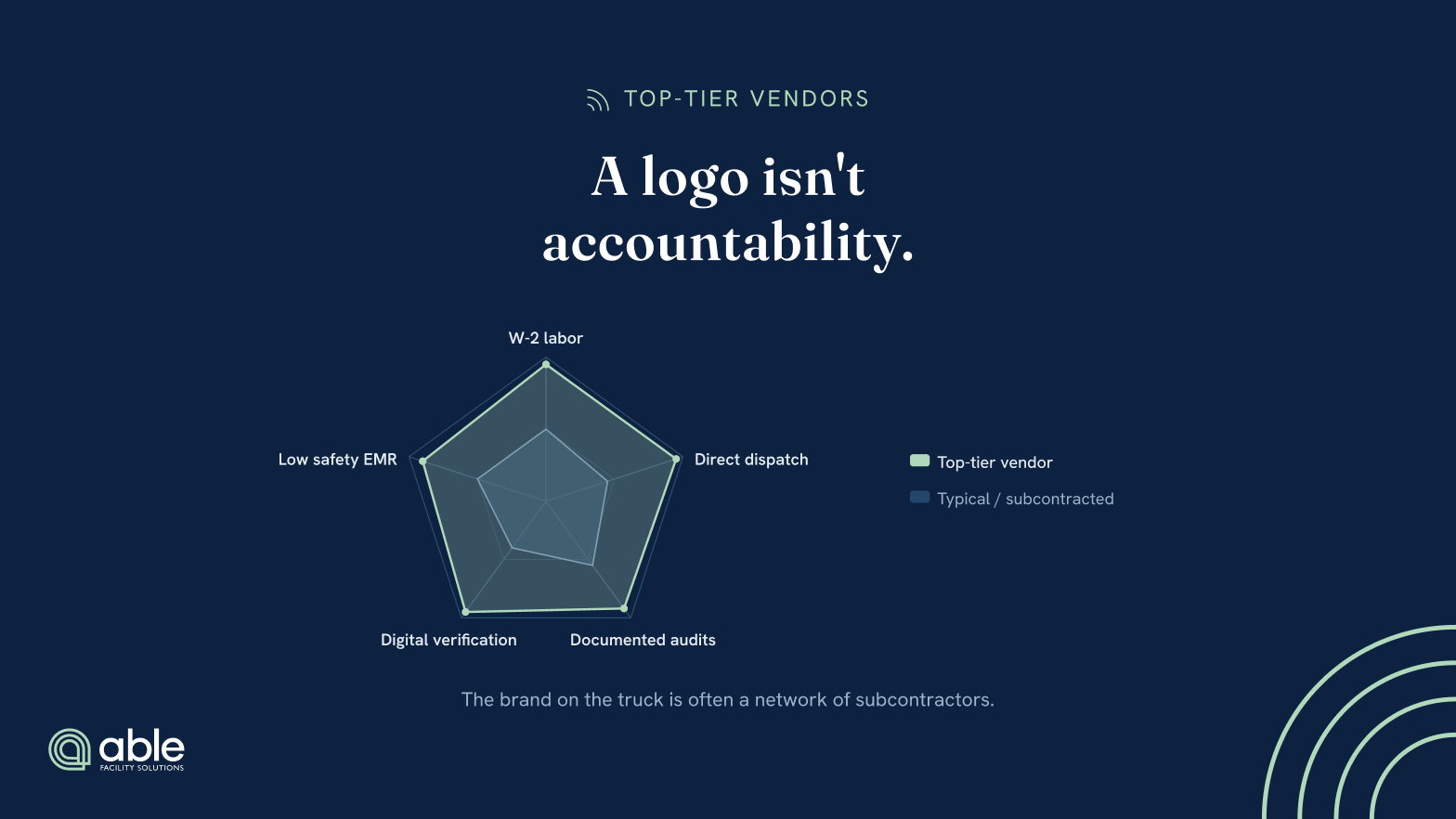
I recommend evaluating vendors based on their daily operations rather than their brochures. Just as specialized criteria are required to evaluate public sector strategy firms based on compliance mastery and contract expertise, facility managers should apply technical benchmarks to cleaning vendors. The following table shows the technical differences between the two primary labor models in the janitorial service market.
Labor model comparison
| Metric | Franchise / Subcontracted | Self-Performed W-2 |
|---|---|---|
| Accountability | Fragmented / Indirect | Centralized / Direct |
| Staff Training | Variable by Subcontractor | Standardized & Documented |
| Response Time | Delayed by Intermediaries | Immediate via Direct Dispatch |
| Site Security | High Risk (1099 turnover) | Low Risk (Vetted employees) |
Enterprise-scale compliance requirements
Maintaining compliance across millions of square feet requires more than a mop and bucket. Even large providers can fail. This happens if they lack a centralized operational platform. It should use a W-2 employment model. This helps ensure direct accountability and staff training. To reach audit-ready levels and manage bio-load effectively, I suggest looking for these specific technical features:
- Real-time GPS tracking and geofencing to verify crew attendance
- Digital inspection reporting mapped to ISSA production rate standards
- Automated compliance tracking for chemical safety and bloodborne pathogen protocols
- Integrated communication portals for emergency response and work order management
Common questions: evaluating janitor services
Is a W-2 labor model always more expensive?
While the hourly rate for a W-2 workforce may seem higher, the total cost of ownership is lower. I have found that direct employment can reduce turnover and liability risks. It also prevents costly service failures and insurance gaps common with subcontractors. These hidden costs often far exceed the nominal savings of a low-bid contract.
How do I verify a vendor's safety claims?
Avoid relying on verbal promises. I recommend asking for the vendor's OSHA 300 logs and their current EMR letter from their insurance carrier. A transparent janitorial partner will provide this documentation in their RFP response.
Can large national companies maintain local accountability?
This level of performance is possible only if the vendor uses a self-performed model. When a national brand subcontracts to a local provider, they add cost without adding quality.
- The most important thing for long-term success is having a consistent and dedicated cleaning crew.
- This team should clean your facility regularly. Stable staffing is the only way to maintain strict technical standards.
Implementation: how to recalibrate your next RFP
To ensure your next contract delivers the accountability you need, follow these five steps:
- 1Audit your current vendor's labor model by requesting W-2 verification for site staff.
- 2Set a minimum safety EMR threshold for all qualifying bidders.
- 3Require documented training logs for specialized tasks like VCT strip-and-wax and disinfection.
- 4Mandate the use of a digital platform for real-time service verification.
- 5Use a technical audit framework to evaluate performance before the auto-renewal date.
Protect your facility and your reputation today by requesting a free, documented walkthrough and quote from our expert team.