
Most facility managers in busy retail and office buildings see floor stripping and waxing as a basic service. They think so until a bad job ruins $50,000 of VCT. In professional office cleaning, the real risk resides in the accountability of the person holding the buffer. High-visibility retail centers and corporate headquarters in the NYC, NJ, and Philadelphia metro areas require more than a clean floor; they require a liability and preservation strategy.
The short answer
Asset preservation for VCT requires W-2 labor to bridge the gap between chemical aggression and safety compliance. Subcontracted models create a liability vacuum where quality standards and insurance coverage often vanish between contract signing and execution. Self-performed labor is the only way to keep a steady APPA rating. It also helps you avoid spending money early to replace floors.
Technical floor care requires oversight to ensure asset longevity. For busy commercial environments, a vendor must manage labor needs and directly oversee the technician. This ensures that safety standards are verified rather than assumed.
The technical reality of commercial floor stripping
Commercial floor stripping is an aggressive chemical process that requires precise timing and mechanical skill. If a technician leaves a high-pH stripper on the floor for too long, the VCT tiles can cup or delaminate. This permanently destroys the bond with the subfloor. General janitorial staff often lack the specific training to recognize these tipping points. Specialized trade knowledge is required to keep the wear layer strong while removing years of dirt.
Charlie Munger, who spent 60 years thinking about risk at the highest levels of finance, gave us the principle every facility director should apply to vendor selection:
“"Show me the incentive and I will show you the outcome." - Charlie Munger, former Vice Chairman of Berkshire Hathaway”
In the field, the difference between a technician and a general laborer shows in the edges and corners. A true floor care professional knows these areas need manual detailing to prevent yellowing, which can signal poor maintenance. This level of detail is rarely found in high-volume subcontracted teams that prioritize speed over technical precision. Without a workforce trained in specialized floor care, facility assets are essentially being experimented on by rotating labor.
Successful floor care depends on more than just a standard buffer. It needs heavy-duty wet vacuums. It also needs auto scrubbers. Use high-solids floor finishes that can withstand thousands of steps each day. Using the wrong floor finish for a traffic pattern can cause scuffs right away or reduce slip resistance. If a vendor uses a low-quality wax that fails to meet COF standards, the property manager must answer for the slip-and-fall claim.
Auditing the specific chemical concentrations your cleaning service uses is essential. Many subcontractors dilute chemicals excessively to save on material costs. This practice leads to a weaker finish that breaks down faster and forces you into more frequent, expensive strip-and-wax cycles. A professional office cleaning service with direct labor oversight ensures that chemistry and equipment meet the highest industry standards.
W-2 labor vs. subcontracting: a risk management comparison
| Performance metric | W-2 self-performed labor | Subcontracted labor model |
|---|---|---|
| Accountability | Direct management and QA oversight | Fragmented third-party reporting |
| Training standards | Verified safety and technical training | Inconsistent or non-existent |
| Insurance coverage | Full worker's comp and general liability | Often tiered or limited coverage |
| Safety compliance | OSHA and bloodborne pathogen certified | Variable and difficult to audit |
The financial impact of improper floor care cycles
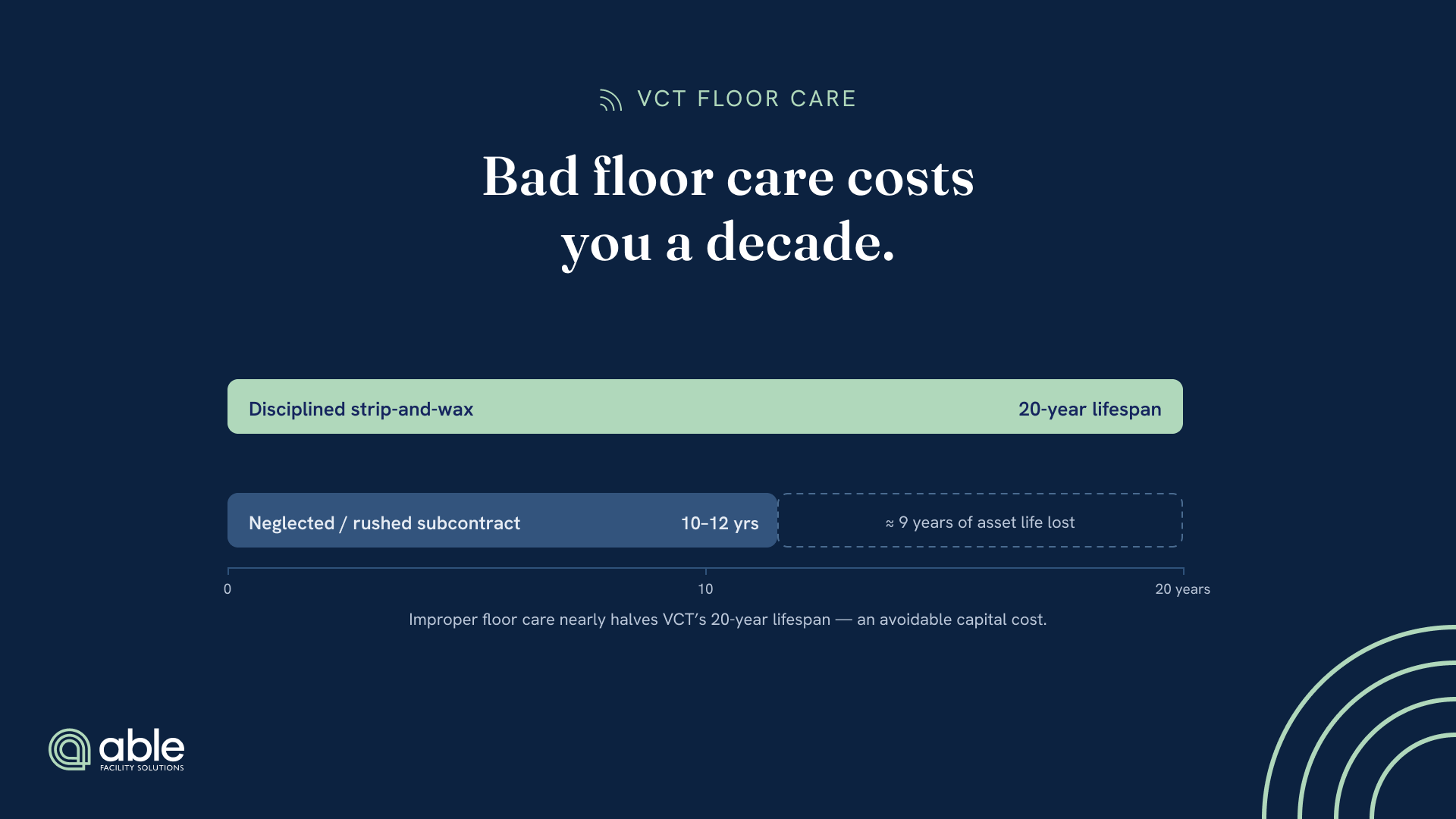
When VCT is neglected or improperly maintained, the damage accumulates. Once the factory wear layer is ruined, the tile becomes porous and absorbs dirt, leading to faster asset decay. Instead of a 20-year lifespan, you may need a full replacement in 10 or 12 years. This is a major hit to your capital budget. It could have been avoided with a strict maintenance schedule.
Nassim Nicholas Taleb, whose *Antifragile* and *Skin in the Game* reshaped how executives think about hidden risk exposure, said it in a line every procurement decision should be measured against:
“"You do not want to have skin in the game, you want to have soul in the game." - Nassim Nicholas Taleb”
Understanding the labor burden is critical for any commercial office cleaning services provider. ISSA production rates define how long a specific task should take, but these rates assume the worker has a baseline level of skill. Subcontractors often underbid jobs by ignoring these rates, which leads to rushed work. The hidden costs of poor floor maintenance include:
- Premature tile replacement costs totaling tens of thousands of dollars
- Increased liability from non-compliant slip-resistance levels
- Downtime for retail or commercial office cleaning when emergency repairs are needed
- Brand damage from visually neglected high-traffic entryways
Auditing your floor care vendor
To protect your facility, ask for copies of the required safety and technical training certificates. These should cover the team stripping and waxing your floors. You should also confirm the workers’ employment status on your site. This helps ensure the primary vendor’s insurance policy protects you. Establish a baseline APPA rating for your current floor conditions with a data-driven facility walk-through. This will set a benchmark for future performance.
Common questions
How often should an office be cleaned and waxed?
High-traffic retail and office environments typically require a full strip and wax once per year. They also need quarterly scrub-and-recoat sessions to maintain the wear layer.
How much does office cleaning cost for floor care?
Costs vary based on square footage and tile condition. Prioritizing the labor model over the lowest price is the most cost-effective strategy. A cheaper subcontracted job that ruins the tile is much more expensive in the long run.
How to get office cleaning contracts that include floor care?
Look for vendors who provide transparent pricing and use technology-driven QA tools to track performance in real time. Able Facility Solutions supports our day porter and floor care services with a 30-day guarantee. This helps ensure we meet brand standards.
If you are ready to stop using unreliable subcontractors, you can better protect your facility’s assets. Schedule a walk-through with Able Facility Solutions today.