
Selecting a pricing model for your facility affects more than your budget. It also shapes asset life and day-to-day service consistency.
The short answer
The ideal pricing model depends on the complexity of your facility. Square-foot pricing works for standard offices but often fails in technical environments with specialized surfaces. Fixed-price contracts offer budget stability and work best with a W-2 workforce to prevent corner-cutting. For strict settings like healthcare or industrial plants, cost-plus models add clear pricing. This helps ensure dwell times and safety standards are met each shift.
Understanding the three primary models
Most commercial cleaning contracts fall into one of three categories. Selecting the right option takes an honest look at your building’s traffic. It also depends on the needs of your flooring and millwork.
| Model | Best for | Pros | Cons |
|---|---|---|---|
| Square-foot | Standard offices | Easy to compare | Ignores technical needs |
| Fixed-price | Budget-conscious | Predictable costs | Risk of corner-cutting |
| Cost-plus | High-compliance | Full transparency | Variable monthly costs |
Square-foot pricing
This is the most common model for generic office space because it provides an easy benchmark for comparison. However, it often fails to account for specialized maintenance. For example, NYC commercial cleaning rates show that high-traffic areas need more work. A flat square-foot rate may not reflect this. If you have expensive VCT or stone flooring, this model might lead to service gaps in specialized care.
Fixed-price contracts
Fixed pricing provides excellent budget predictability. The risk is that commercial cleaning vendors might reduce labor hours to protect their margins. Without the accountability of a W-2 workforce, fixed-price models can incentivize subcontractors to rush through tasks. This model works best when the scope of work is clearly defined and audited regularly against performance guarantees.
Cost-plus models
Cost-plus pricing is the gold standard for transparency. You pay for the actual labor and supplies plus a fixed management fee. This is ideal for facilities where compliance is more critical than speed. It ensures that staff never feel pressured to skip steps like required dwell times for disinfectants.
Why labor models impact pricing
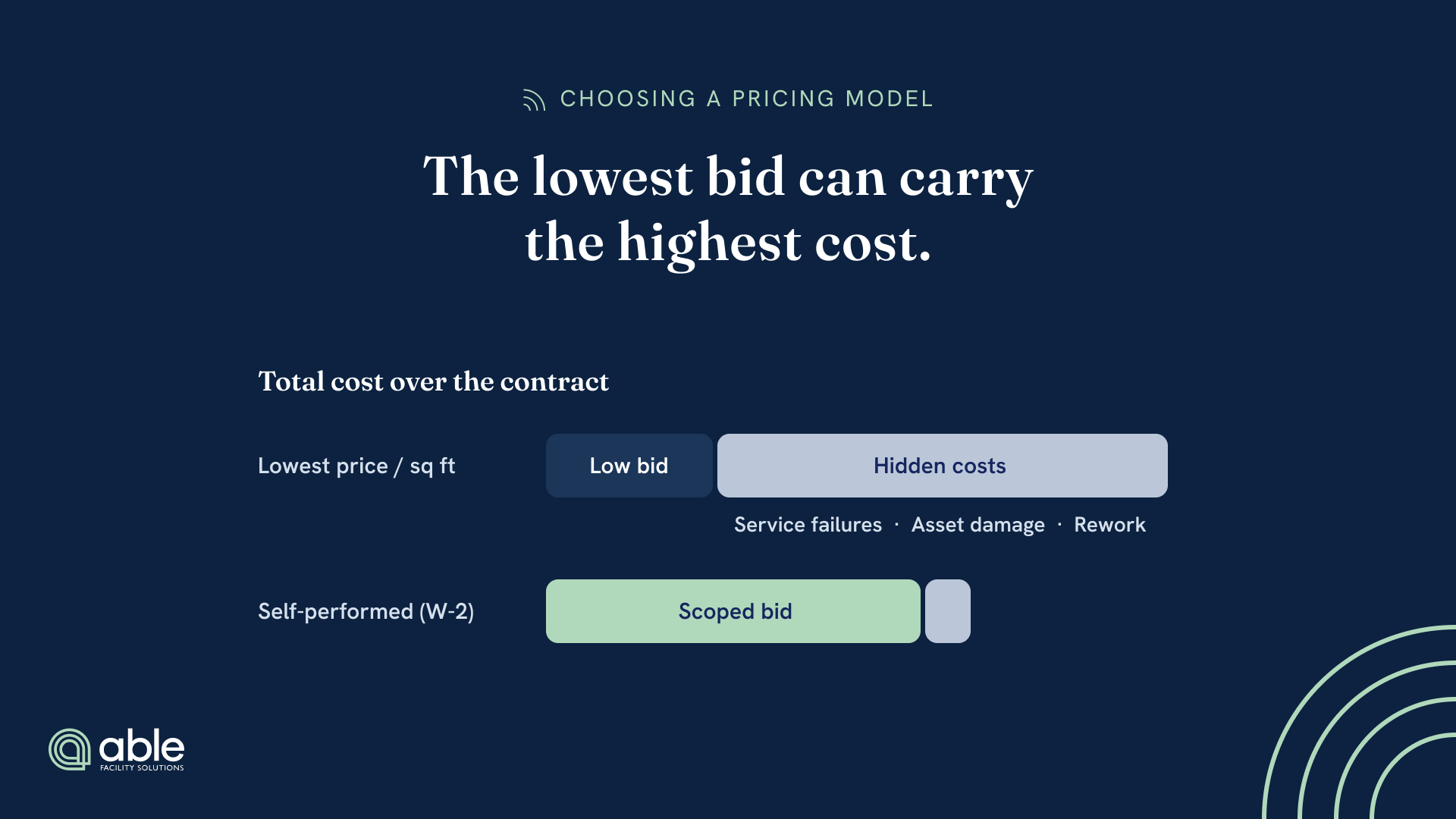
Every pricing model is underpinned by labor. When comparing quotes, you must normalize the scope to understand how to get cleaning contracts that actually deliver results. A lowball offer often hides the hidden overhead of managed labor.
A self-run W-2 model may cost more at first. But it avoids costs from service failures mid-contract and damage to assets. This is why scoping for asset preservation is a better long-term financial strategy. It works better than chasing the lowest price per square foot.
Procurement for specialized services
When evaluating commercial cleaning vendors, look for specialized expertise in your specific facility needs. Standard office cleaning contracts often miss the technical requirements for industrial or medical environments:
- Air duct cleaning: Necessary for maintaining air quality and HVAC efficiency in high-dust environments.
- Carpet cleaner cycles: Scheduled extraction prevents fiber damage and avoids premature replacement costs.
- Drain cleaning: Critical for food service or industrial labs to prevent backing up during production.
- Performance guarantees: Ensure that performance guarantees membrane cleaning vendors or technical teams meet specific safety KPIs.
Common questions
How do I switch pricing models mid-contract?
Start by requesting a transparent breakdown of current labor hours. Use this data to negotiate a transition to a model that better aligns with your facility traffic. Most commercial cleaning vendors will accommodate a shift if the scope is clearly defined.
What is the most transparent pricing for VCT care?
Project-based pricing within a cost-plus or fixed-price contract is best. This ensures that the technical steps of stripping and waxing are not bundled into generic janitorial tasks. This is how to get commercial cleaning contracts that protect long-term asset value.
Is a house cleaning service different from office cleaning contracts?
Yes. Residential services focus on domestic aesthetics. Office and industrial contracts require specialized insurance, SDS compliance, and heavy-duty equipment like floor scrubbers and HEPA vacuums. Ready to learn how to get commercial cleaning contracts that scale? Book a call with our team today to discuss your specific needs.