
*Understanding the technical hierarchy of hygiene is the difference between safe compliance and a massive facility liability.*
Louis Pasteur, whose germ theory work built the entire foundation of modern hygiene protocols, said it in a line that still applies to every commercial facility contract:
“"The role of the infinitely small in nature is infinitely great." - Louis Pasteur”
The short answer
Cleaning is the physical removal of soil, but it does not kill pathogens. Sanitizing reduces germ counts to safe levels, while disinfecting kills bacteria and viruses on surfaces. For a facility to remain safe, staff must follow a specific order of operations. You must ensure an EPA-registered disinfectant meets its required dwell time. Do this without damaging building assets, like VCT flooring.
The three levels of professional hygiene
Facility managers often use these terms interchangeably, but they represent distinct chemical processes. Confusing them leads to two major risks: failing to eliminate pathogens or overusing harsh chemicals that strip floor finishes. Proper hygiene requires a tiered approach that prioritizes both human health and asset preservation.
Level 1: Cleaning and soil removal
Cleaning is the fundamental first step. It uses soap or detergent to physically remove dirt, dust, and organic matter from surfaces. According to the CDC, cleaning removes germs rather than killing them. Without this step, disinfectants cannot reach the surface to work effectively. Office cleaning frequency by facility type determines how often this basic maintenance occurs to prevent biofilm buildup. A residential house cleaning service often follows similar protocols for surface hygiene.
John Snow, the physician whose 1854 map of a London cholera outbreak established the entire field of modern epidemiology, understood the compounding cost of skipped basics:
“"You have nothing to do but to mend the pavement, and the mortality will disappear." - John Snow”
Level 2: Sanitizing for public health
Sanitizing lowers the number of germs on surfaces to levels considered safe by public health standards. It is a common requirement in food service and high-traffic common areas. While faster than disinfecting, it does not eliminate all viral threats. It serves as a middle ground for surfaces that require frequent, rapid treatment throughout the day.
Level 3: Disinfecting and dwell times
Disinfecting kills germs using specialized chemicals. To be effective, these products must remain wet on the surface for a specific duration, known as dwell time. If you fail to meet this duration, pathogens may survive. This is why documented frequencies and objective auditing are critical for verification. MedlinePlus notes that skipped steps in this process leave a facility at risk.
Ignaz Semmelweis, the Hungarian physician who discovered handwashing dramatically reduced mortality in maternity wards decades before germ theory was accepted, framed the case for protocol adherence in a line worth pinning above every janitor closet:
“"The truth we discover today is often what we ignored yesterday." - Ignaz Semmelweis”
Cleaning vs. sanitizing vs. disinfecting comparison
| Process | Action | Goal | Application |
|---|---|---|---|
| Cleaning | Removes dirt | Appearance | All surfaces |
| Sanitizing | Reduces germs | Health safety | Food prep, gyms |
| Disinfecting | Kills pathogens | Infection control | Restrooms, touchpoints |
Protecting your facility assets
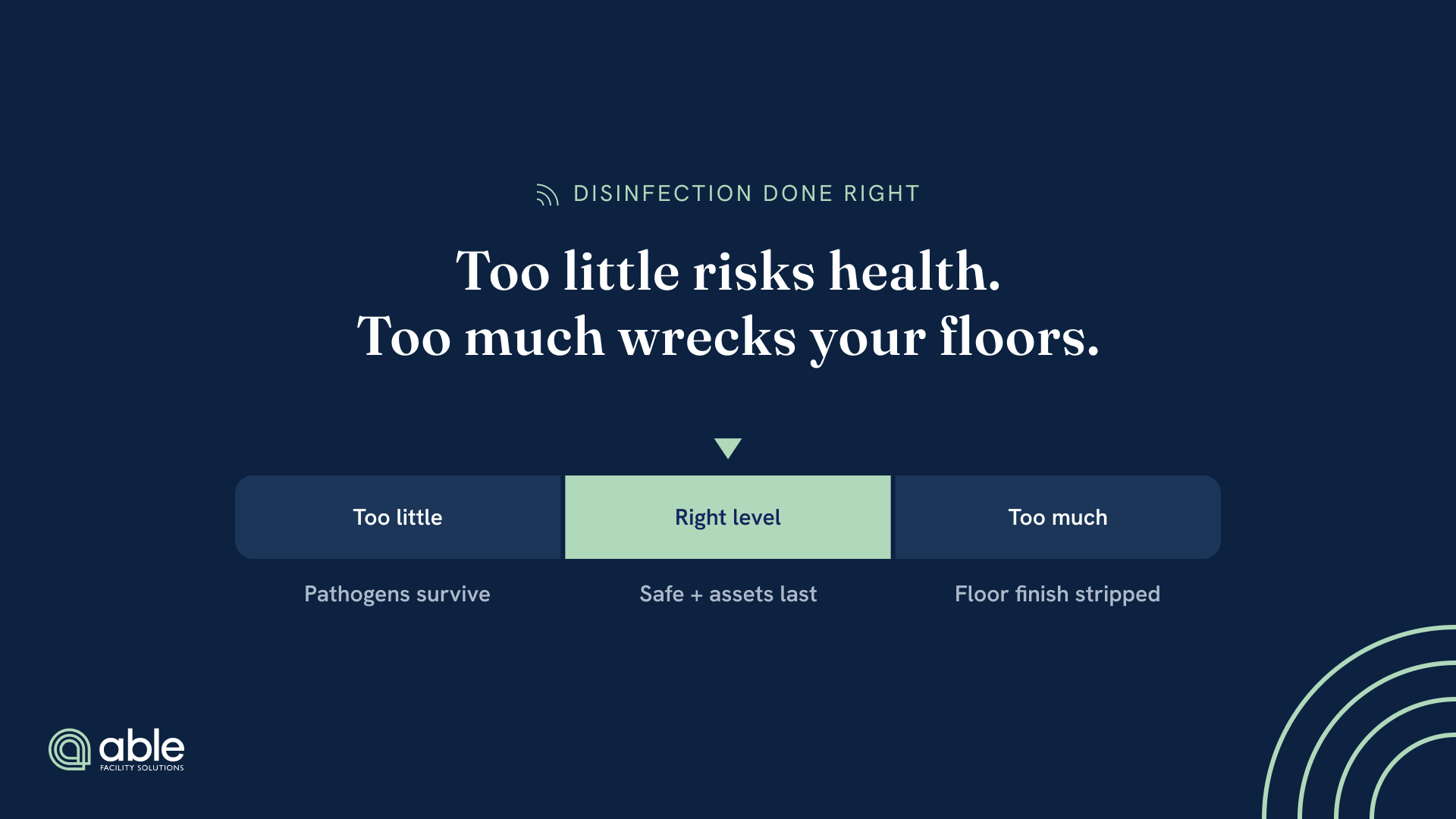
Improper chemical use is a leading cause of premature asset failure. Overuse of harsh disinfectants on VCT flooring without proper sealing leads to surface damage. When chemicals pool or are mixed at the wrong concentrations, they eat through the wax. This requires an expensive strip and wax service earlier than planned. This is why school custodial program scoping must focus on asset preservation alongside health. Specialized tasks may require a carpet cleaner to handle textile surfaces safely.
Standard facility maintenance standards:
- Use only an EPA-registered disinfectant for high-touch areas
- Verify dwell times for every chemical in the SDS binder
- Ensure cleaning occurs before any disinfecting step
- Train staff on the specific needs of VCT and stone surfaces
- Audit commercial cleaning vendors for adherence to technical specs
- Review performance guarantees membrane cleaning vendors use for specialized filtration systems
The process for commercial cleaning contracts:
- 1Perform a physical rough-clean to remove bulk soil.
- 2Apply sanitizers to food-contact or low-risk surfaces.
- 3Apply disinfectants to high-touch points and restrooms.
- 4Monitor dwell times to ensure chemical efficacy.
- 5Document the completion of each stage for compliance.
Managers often ask how to get cleaning contracts that include detailed office cleaning contracts for their specific needs.
Common questions
What is the most common mistake in disinfecting?
Ignoring dwell time is the most frequent error. If a worker sprays and immediately wipes, they are cleaning, not disinfecting. The surface must stay wet for the full time listed on the label to kill targeted pathogens.
Can I skip cleaning and go straight to disinfecting?
No. Soil and oils act as a shield for germs. Disinfectants are neutralized by organic matter, so the surface must be visibly clean first. This logic applies to everything from a small desk to complex air duct cleaning or drain cleaning protocols.
How to get commercial cleaning contracts with high standards?
Facility managers should look for providers who use a W-2 workforce rather than sub-contractors. This ensures that technical specs and dwell times are followed every single shift. At Able Facility Solutions, we provide the accountability needed to maintain these standards consistently. If you are researching how to get commercial cleaning contracts, focus on quality and compliance.
Ready to elevate your facility standards? Book a call with Able Facility Solutions today. commercial cleaning vendors.