
Most facility managers at busy commercial and retail sites lose points. This happens because their cleaning partner does not have strong administrative processes. These processes are needed for a USGBC audit. I have found that many facilities fail their review because they lack verifiable records rather than poor cleaning quality. In my experience, technical documentation is the real bottleneck for certification. Choosing professional commercial janitorial services matters. Earning LEED O+M credits takes planning. It treats maintenance as a way to protect assets and cut costs.
Rick Fedrizzi, who co-founded the US Green Building Council and ran it as CEO for fourteen years, has described what LEED was built to correct. Class A office space, he recalled, meant Italian marble in the hall and expensive fixtures in the bathroom:
“"It was a broken model for what mattered."”
Rick Fedrizzi, co-founder, US Green Building Council
The short answer: commercial janitorial services and LEED
A specialized custom facility cleaning plan partner facilitates LEED credits by implementing a sustainable cleaning policy. This requires tracking chemical purchasing, equipment maintenance, and custodial training. These tasks are best managed by a stable W-2 labor model. At Able Facility Solutions, we have seen that busy retail and office spaces need more frequent records. This helps track higher chemical and equipment use.
The LEED IEQc3.3 requirement: documented green cleaning
Chemical purchasing standards
I recommend starting with the IEQc3.3 mandate. This requires a comprehensive sustainable cleaning policy. This mandate defines specific documentation for at least 30% of your total chemical spend. You must show that your products meet CIMS-GB and Green Seal certifications. Without a partner, it is hard to prove compliance during an audit. The partner should be able to provide detailed purchase logs. The partner should also offer specialized janitorial services.
Partners must understand the technical hierarchy of cleaning, sanitizing, and disinfecting to ensure dwell times align with safety standards. This technical alignment improves audit scores. It also lowers operational risk for property managers. This applies to the NYC and Philadelphia metro areas.
Equipment maintenance logs
Sustainable cleaning equipment must be designed to reduce building contaminants and minimize environmental impact, according to LEEDuser. Your commercial floor care equipment must be tracked. Keep records that show vacuums are HEPA-certified. Also show floor buffers run below 70 dBA. I have seen facilities lose points because they could not produce service records for their machinery. Consistent commercial floor care services ensure these logs are audit-ready, preventing immediate credit loss.
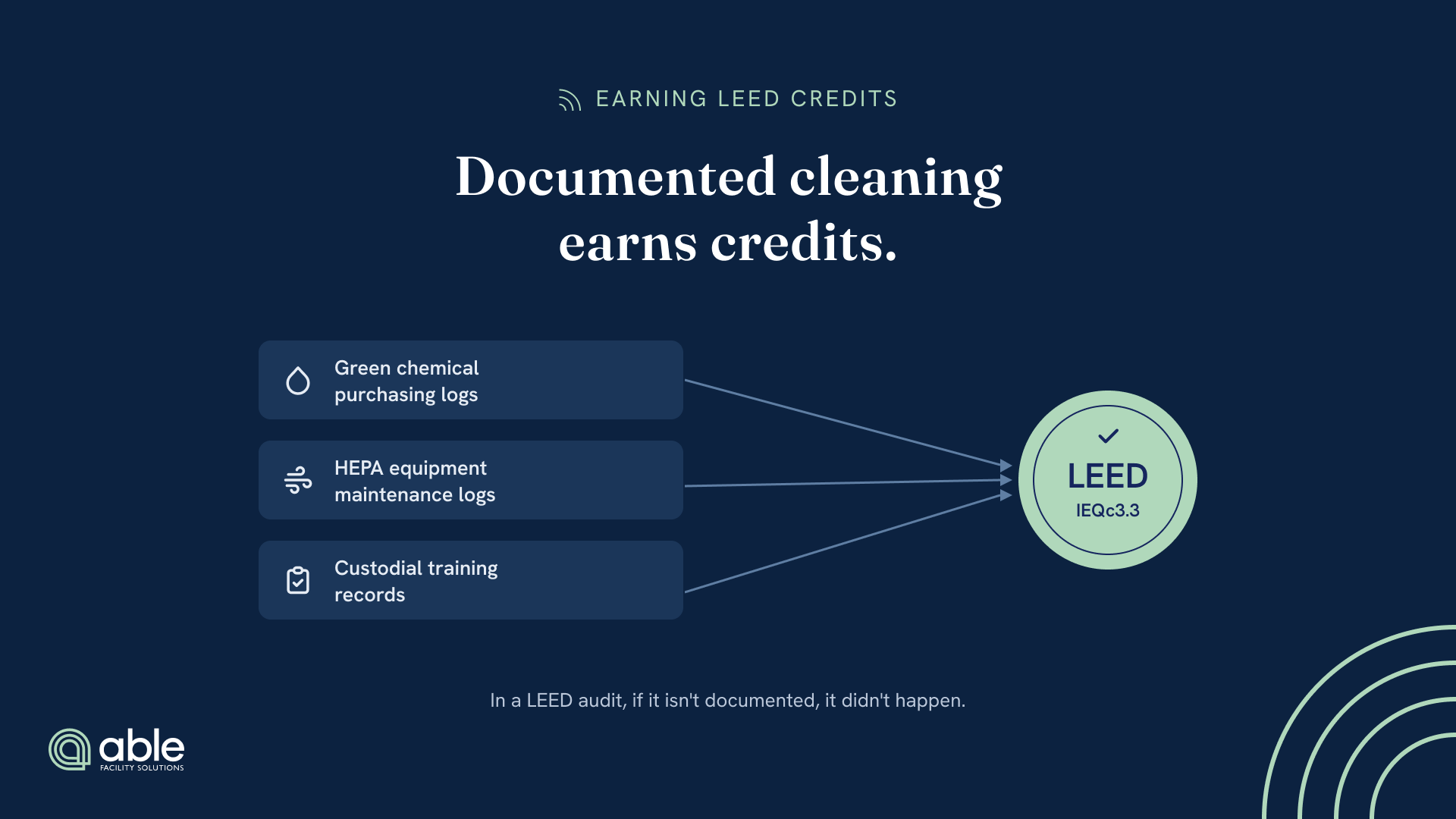
3 ways your janitorial partner earns you credits
- 1Conducting monthly facility cleaning audits to ensure 90% of cleaning products meet sustainability criteria.
- 2Maintaining digital logs of all equipment maintenance to prove OSHA and LEED compliance through expert commercial cleaning services.
- 3Providing certified custodial training records that confirm staff expertise in sustainable practices. This is backed by our 30-day guarantee on service quality.
The documentation gap: why subcontractors fail the audit
I have observed that subcontracted labor chains are a primary reason for documentation failure. When you use brokers, information is fragmented. A dedicated workforce from a reputable commercial cleaning company provides the accountability needed for data integrity. Because we hire our teams as W-2 employees, we require digital tracking tools. These tools must meet government and municipal compliance standards. These tools make service delivery auditable, which is critical for high-visibility retail centers.
Audit compliance by labor model
| Compliance Factor | Subcontracted Brokers | Self-Performed W-2 |
|---|---|---|
| Data Integrity | Fragmented | Centralized |
| Audit Readiness | Reactive | Proactive |
| Training Logs | Third-party managed | Directly documented |
Frequently asked questions
How does janitorial service impact LEED O+M scores?
Your cleaning partner impacts the Indoor Environmental Quality category. Their ability to document chemical spend, HEPA filtration, and APPA cleanliness levels determines your eligibility for specific credits.
What is IEQc3.3?
It is the LEED credit for Green Cleaning Policy. It requires a facility to mandate sustainable purchasing, equipment standards, and chemical handling protocols to reduce environmental impact.
Why is documentation more important than the cleaning itself?
In a LEED audit, if a task is not documented, it did not happen. You can use high-quality chemicals, but without a purchasing log that proves they meet CIMS-GB standards, you will not receive credit.
Preparing for a LEED audit
- Compile all current Safety Data Sheets for on-site chemicals.
- Verify that all VCT maintenance logs are up to date and include chemical brand names.
- Audit your vacuum fleet for HEPA filtration certification.
- Schedule a facility audit to identify current gaps in your sustainable policy and overall facility management services.
Schedule a facility audit today to support your LEED certification. Ensure your records match your operational goals. Choose to schedule a walk-through with Able Facility Solutions.