
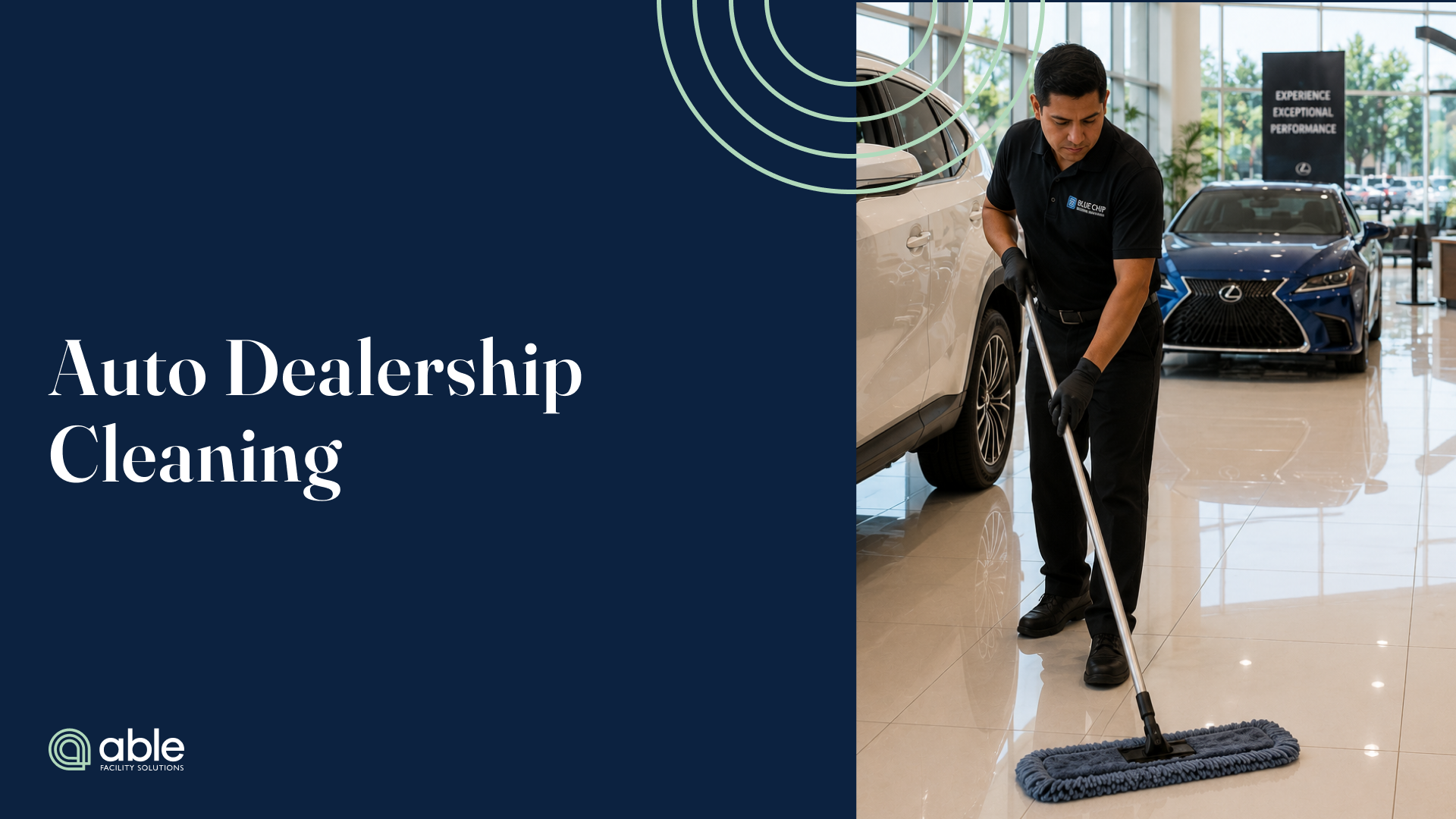
A pristine showroom sells cars, but a greasy service bay kills margins. Managing both requires a dual-standard approach that bridges retail luxury and technical industrial utility. For many facility managers, choosing the right cleaning partner matters a lot. It can help create a high-performing showroom. Or it can lead to a workshop with more liability risks. Many managers research how to get janitorial contracts to ensure they find a vendor capable of this balance.
The short answer
Auto dealership cleaning requires high-end VCT maintenance for showrooms and technical degreasing for service bays. To protect dealership assets, facility managers must use regular strip-and-wax programs and EPA-registered degreasing protocols. Subcontracted 1099 crews often fail this dual-environment challenge, making a W-2 cleaning crew essential for accountability. We use documented schedules and audits to ensure front-of-house and back-of-house areas meet manufacturer standards. While we focus on cars, we use medical-grade cleaning standards from California medical facilities. We apply them to our showroom’s high-touch areas.
| Feature | Showroom (Front-of-House) | Service Bay (Back-of-House) |
|---|---|---|
| Primary Goal | High-end aesthetic / Class A retail luxury | Technical industrial utility and safety |
| Floor Care Method | VCT maintenance (strip-and-wax) | Technical degreasing and mechanical scrubbing |
| Visual Standard | Polished, mirror-like shine; streak-free glass | Neutralized spills; oil and fluid removal |
| Chemical Focus | High-solids floor finishes | EPA-registered degreasers and neutralizers |
| Liability Focus | Asset preservation and inventory highlighting | Slip-and-fall prevention and hazard mitigation |
| Maintenance Type | Retail-grade sanitation | Industrial-grade floor care |
The dual-standard requirement for commercial cleaning services
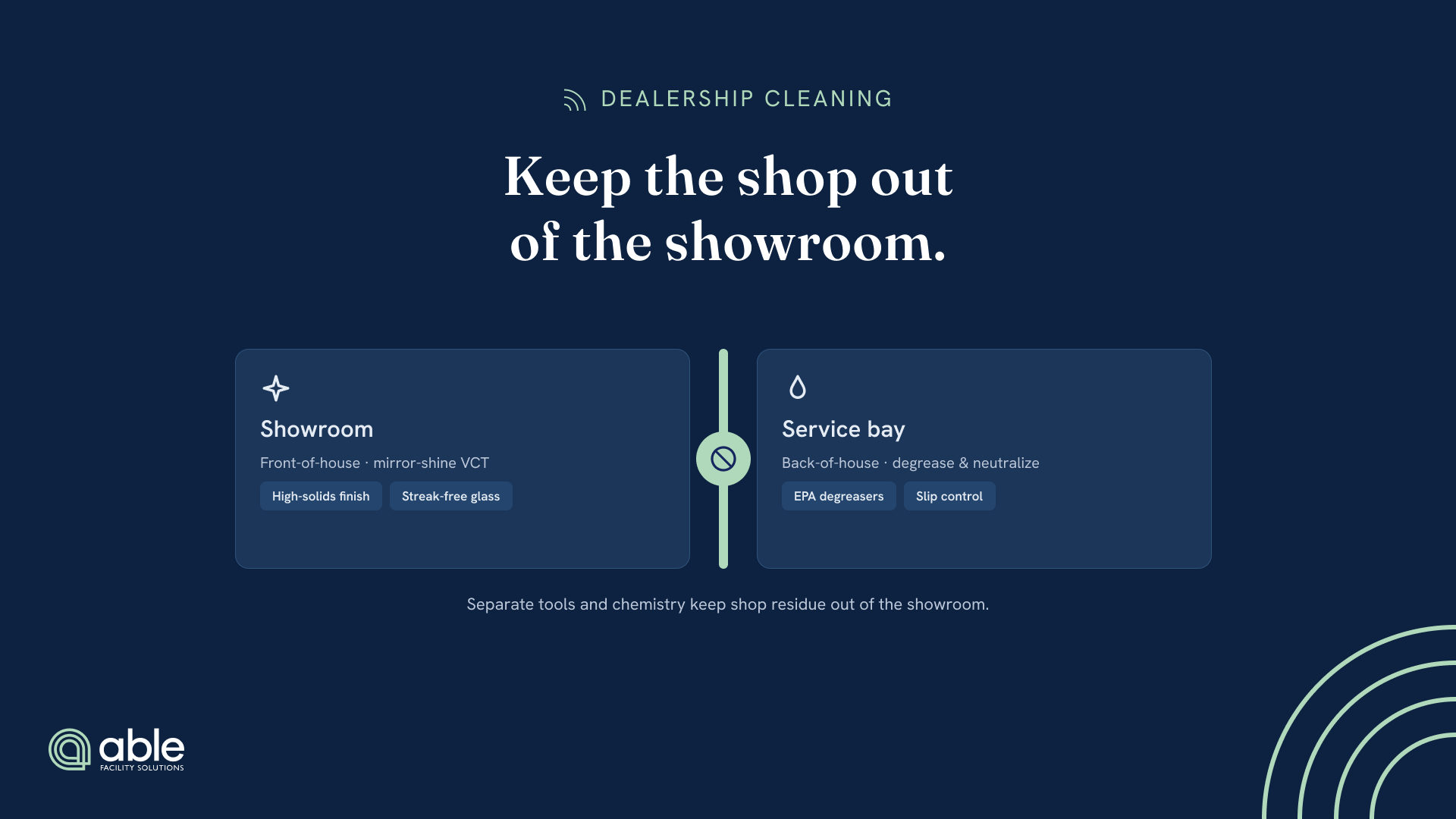
Dealerships require a unique blend of high-end aesthetic VCT maintenance and technical industrial sanitation in a single site. The showroom must work like a Class A office building. It needs polished floors and streak-free glass to highlight the inventory. Simultaneously, the service department needs industrial-grade floor care (Able Facility Solutions). It handles oil, heavy fluids, and heavy foot traffic. If a vendor uses the same tools for both, they risk cross-contaminating the facility. Our expertise in manufacturing facility cleaning ensures that industrial zones remain compliant.
Professional teams must distinguish between these zones to prevent chemical residue from the shop from reaching the showroom floor. Our approach uses documented schedules (Blue Chip Building Maintenance) to confirm specialized cleaning happens on time. This keeps the showroom a premium sales space and the shop safe. This level of oversight is common in hospitality cleaning and other high-standard sectors.
Showroom floor longevity and asset preservation
Proper VCT maintenance programs
Showroom floors are a high-value asset that requires a proactive strip-and-wax program. Standard cleaning services often neglect the build-up of old wax, leading to a yellowed, dull appearance. We use high-solids floor finishes that give a durable, mirror-like shine and hold up under heavy vehicles. This technical approach to floor care prevents permanent surface degradation. Many facility managers secure these specialized results by negotiating comprehensive janitorial cleaning contracts that specify floor care frequencies.
Service bay safety and compliance
Technical degreasing is essential to maintain safety standards and prevent slip-and-fall liabilities in service departments. Oil and coolant spills must be neutralized with the right chemicals. This keeps the liquids from damaging concrete or epoxy sealers. A professional cleaning company provides digital logs verifying that these hazardous zones are addressed daily. For facilities with very high foot traffic, day porter services can provide ongoing upkeep during business hours. Our comprehensive facilities management approach ensures every square foot is monitored.
How to compare dealership cleaning vendors
- Verify W-2 employment status to ensure consistent training on technical degreasing protocols.
- Confirm VCT refinishing experience specifically with high-solids finishes meant for vehicle weight.
- Request a sample auditing log to see how they verify dwell times and chemical neutralization.
- Standardize the scope by splitting square footage between retail-grade and industrial-grade zones.
Common questions
What is commercial cleaning in an auto dealership?
It is a comprehensive maintenance program covering high-end retail showrooms, administrative offices, and industrial service bays with area-specific protocols. It needs a dual-standard approach. Treat the front-of-house as a Class A space. Treat the back-of-house as a technical industrial zone. Unlike standard hospital cleaning services, dealership agreements account for specialized chemical handling. Our protocols are as rigorous as those used in hospital cleaning or data center cleaning to ensure zero contamination.
What does commercial cleaning consist of for service bays?
It involves mechanical scrubbing with strong degreasers, clearing trench drains, and removing moisture to prevent slips. These protocols are designed to neutralize hazardous fluids without damaging the underlying concrete or epoxy sealers. This is as critical as the sanitation required for hospital cleaning in medical environments.
How to calculate commercial cleaning rates for dealerships?
Rates are based on a split-square footage model. This model accounts for the different labor intensities of showroom glass vs. industrial floor scrubbing. Typically, costs are split by how often VCT burnishing happens in the showroom. They also depend on daily degreasing in the service department.
Specialized maintenance is the only way to preserve dealership facility value. Ready to elevate your facility standards? Book a call with Able Facility Solutions to schedule a technical facility audit today.