

Most facility managers treat a janitorial renewal as an administrative formality, but technical reality suggests otherwise. For property managers in NJ, NY, and Philadelphia, contract renewals are a great time to improve your services.
This is especially true if you manage busy retail centers or office buildings. You can use the renewal process to fix service gaps. If you do not fix them, those gaps can affect your facility all year. Too many directors fall into the "renewal trap." They approve subpar performance because the auto-renewal date came up fast. I have found that a contract is only as good as its documented labor model and its service level agreements. Realizing long-term savings means looking beyond the bottom line. You must audit how well your commercial cleaning services are done.
The short answer: auditing commercial cleaning services
To improve facility hygiene and budget efficiency, your renewal audit must prioritize labor transparency and technical scope. By moving from a broker-based model to a self-performing W-2 workforce, you can reduce communication gaps. You can also lower insurance risks that often come with subcontracting. A successful renewal depends on auditing performance against current traffic patterns, verifying risk management compliance, and stopping auto-renewal clauses before the legal deadline.
The renewal audit: beyond the bottom line
Reviewing auto-renewal clauses
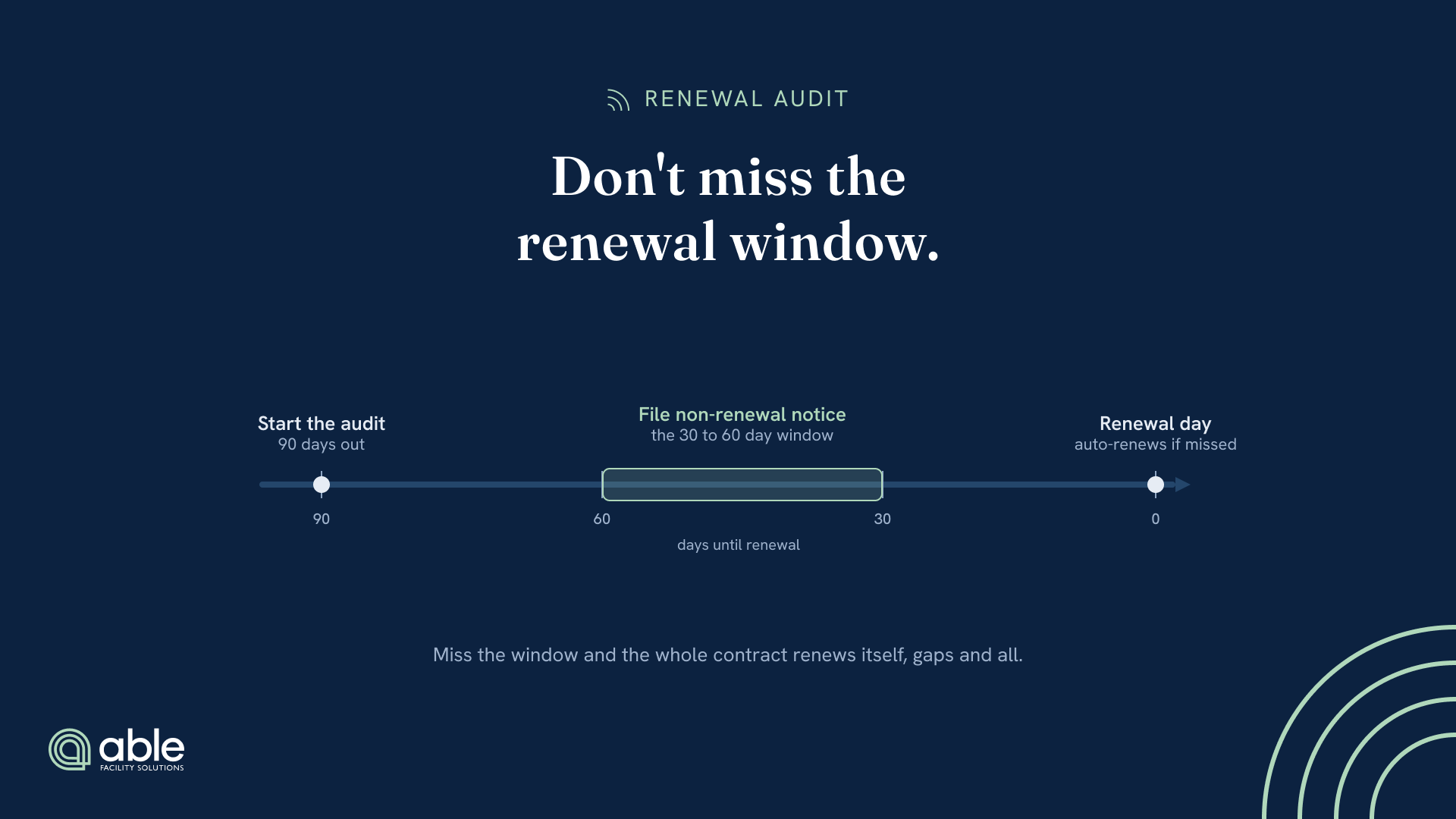
I recommend that facility directors begin their audit at least 90 days before the contract expires. Most janitorial services have auto-renewal clauses. These clauses keep the same terms if you do not send a non-renewal notice on time. The notice window is often 30 to 60 days. Failing to flag these dates can lead to another year of service. It may no longer fit your growing space or changing occupancy rates.
Stopping this cycle requires a formal review of the legal language regarding price hikes and termination rules. If your current provider has not met performance benchmarks, the renewal period is your primary leverage. To prevent hidden costs and ensure accountability, facility managers should verify that every deliverable is documented in an itemized work scope before signing. I have seen many organizations lose thousands of dollars in potential savings. They let a contract renew automatically. They did not do a technical audit.
Assessing performance against SLAs
Performance assessment must be rooted in data, not stories. I suggest reviewing response times for emergency calls. Also check how consistent scheduled tasks are, like floor care and high-dusting. If your provider cannot produce quality audits, you are likely paying for service that exists only on paper.
Evaluate whether the vendor has met the pathogen kill rates and dwell times required for clinical-grade disinfection. In high-visibility settings, the difference between “looking clean” and being truly sanitary affects liability. It often requires clinical-grade disinfection standards to meet compliance. If the vendor has fallen short, make renewal contingent on a rigorous facility cleaning audit framework. Use it to objectively measure future performance.
Labor model transparency: W-2 vs. subcontracting
The most significant risk in janitorial cleaning services today is the use of subcontracted labor. Brokers often sell a contract and then flip the work to 1099 independent contractors who lack proper training. I firmly believe that W-2 labor risk management is your best tool for ensuring direct accountability and consistent quality. Furthermore, ensure the renewal document includes transparent labor allocation. This helps avoid performance triggers and scope creep. Poorly defined service agreements often suffer from these issues.
Labor model comparison
| Labor feature | Self-performing (W-2) | Broker (1099) |
|---|---|---|
| Accountability | Direct supervision and training | Limited oversight of third parties |
| Insurance risk | Full workers' comp and liability | Frequent gaps in coverage |
| Quality control | Consistent, documented SOPs | Variable standards by subcontractor |
| Communication | Single point of contact | Complex, fragmented reporting |
Technical scope adjustments for 2026
High-traffic zone recalibration
Facility usage patterns are rarely static. As you near renewal, I suggest a walk-through to find new high-traffic areas. These areas may need a day porter to clean more often. The resulting custom facility cleaning plan must account for these shifts. It should align labor hours with real building demand. This helps prevent early wear on floors and fixtures.
Floor care and VCT maintenance cycles
Asset preservation is the core goal of any technical janitorial program. During renewal, verify that the scope of work includes specific schedules for VCT strip-and-wax cycles and stone care. Neglecting these technical specs to save on monthly costs is a mistake that leads to a six-figure cost for floor replacement later. Many experienced commercial cleaning contractors will tell you that proactive floor maintenance is cheaper than reactive repairs.
Technical specifications to review include:
- VOC emissions: Ensure all chemicals meet Green Seal or CIMS-GB standards for indoor air quality.
- Dwell times: Confirm that disinfectants sit for the manufacturer-specified time to work correctly.
- Equipment maintenance: Verify the use of HEPA-filter vacuums to reduce airborne allergens.
- Microfiber protocols: Require a color-coded system to prevent cross-contamination between restrooms and common areas.
How to compare janitorial service vendors
- 1Request a labor breakdown: Ask for proof that all onsite personnel are W-2 employees. This helps ensure you do not take on 1099 liability.
- 2Verify insurance certificates: Confirm the vendor has active general liability and workers' compensation policies that meet your requirements.
- 3Audit the supervision ratio: Determine how many buildings each area manager oversees to ensure your facility receives enough attention.
- 4Review technical SOPs: Examine their documented procedures for specialized tasks like terminal cleaning or high-performance floor care.
- 5Check references for similar facilities: Speak with other operations directors at similar institutions to verify the vendor's reliability.
If the comparison shows a need for change, follow a structured vendor transition roadmap. This helps avoid service gaps during onboarding. Leading commercial cleaning companies often provide this type of roadmap to ensure a seamless transition between service providers.
Common questions about janitorial renewals
What is commercial cleaning versus janitorial services?
Janitorial services typically refer to daily maintenance like trash removal and restroom cleaning. Commercial cleaning often involves specialized, deep-cleaning tasks done less often, such as carpet extraction or window washing. Your contract should clearly define the frequency of both.
How much to charge for commercial cleaning?
Pricing is generally based on square footage, facility type, and labor hours. However, the lowest price often indicates a broker model with high turnover. I recommend focusing on the total cost of ownership, including the cost of replacing assets if maintenance is ignored.
Why hire a commercial cleaning service with W-2 employees?
W-2 employees provide a higher level of security and performance consistency. The employer directly controls training and schedules. This lowers the risk of service gaps and security breaches. This risk is lower than with subcontracted labor.
Protect your facility and reputation today. Request a free documented walkthrough and quote from our expert team at Able Facility Solutions.