
A low-bid janitorial contract looks like a win on the balance sheet. That changes fast when someone slips in a busy retail center. It also changes when a chemical spill ruins $50,000 of flooring in an office building. In my experience managing commercial properties across New York, New Jersey, and Philadelphia, the most expensive contract is the one that fails to define its own liability boundaries. I have found that many property managers view commercial cleaning as a simple commodity task, when it is actually a serious exercise in risk management. The difference between asset preservation and asset decay often hides in the fine print of a Service Level Agreement.
Nassim Nicholas Taleb has reshaped how executives see risk and hidden fragility. He offered the perfect framing for vendor selection:
The short answer: A contract you can enforce needs a clear SLA. The SLA must define exactly what “clean” means. It should also use a W-2 labor model for direct accountability.
Defining the scope of work for commercial cleaning
Starting every agreement with a granular list of tasks prevents a liability vacuum. For high-visibility retail spaces and corporate offices, I recommend stating how often key tasks happen. These tasks include floor care and day porter services. Reviewing a detailed breakdown of contract components helps make labor allocation and task frequency clear. This helps prevent budget creep. High-traffic facilities must ensure their scope includes clear performance standards to maintain brand appearance and safety.
The W-2 accountability advantage
I believe the greatest risk to a high-visibility facility is the use of 1099 subcontractors. The chain of command breaks when a vendor brokers out your commercial cleaning services janitorial. A W-2 labor model makes cleaning staff direct employees. It gives better oversight, steady training, and clear insurance coverage. This W-2 labor risk management is a reliable way to ensure workers in your building are covered. They will be covered by the policies you require.
Labor model comparison
| Contract feature | W-2 self-performed model | 1099 subcontracted model |
|---|---|---|
| Liability chain | Direct and transparent | Fragmented and opaque |
| Staff training | Verified safety standards | Inconsistent or unverified |
| Insurance proof | Single policy coverage | Tiered, high-risk coverage |
| Accountability | Direct management control | Brokered communication |
Three essential clauses for liability mitigation
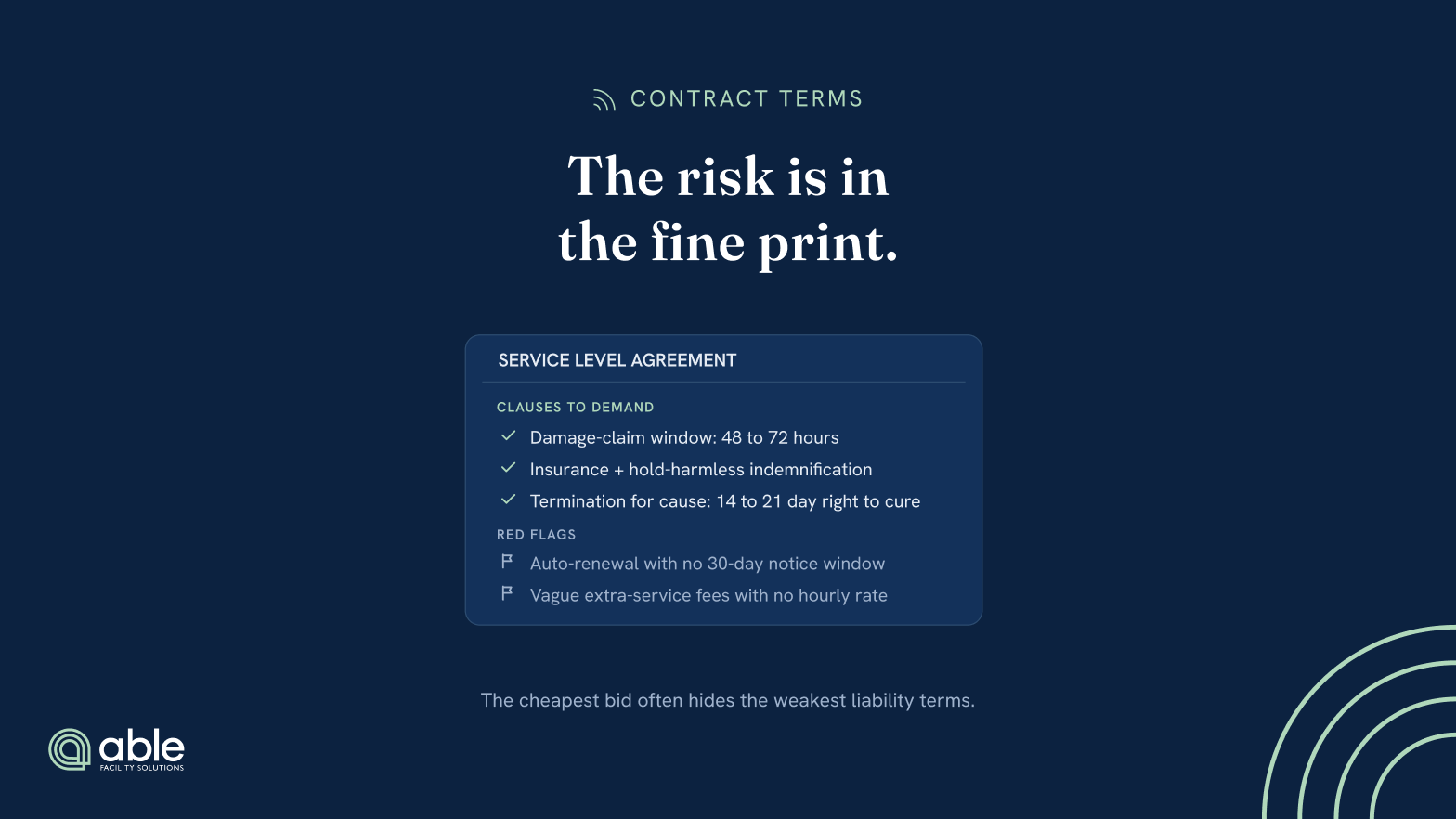
To protect building assets, I have found that three clauses must be non-negotiable in your agreement. While it is for home renovations, a standard service contract checklist still offers a helpful baseline. It can help you spot missing legal and financial protections in your commercial janitorial draft.
- 1Damage claim windows: Establish a strict 48-72 hour window for damage claim notifications. Without this window, clients often lose the legal ability to contest claims raised weeks after a service visit.
- 2Insurance and indemnification: Ensure the vendor carries comprehensive general liability and workers' compensation. The contract should include a hold harmless agreement to protect the property owner from claims caused by vendor negligence.
- 3Termination for cause: Mandate a specific right to cure period. Effective contracts include a 2-3 week period for providers to fix documented service issues after a written notice. Only then can the agreement be dissolved. These performance-based termination triggers help maintain service standards.
Red flags in the fine print
When reviewing a janitor service contract for a commercial or retail property, I recommend looking for these indicators of a low-quality provider:
- Vague 'extra service' fees that are not tied to a specific hourly rate or task.
- Lack of performance KPIs or documented day porter inspection schedules.
- Auto-renewal traps that lack a 30-day non-renewal notice window or fail to offer a 30-day performance guarantee. Using a technical audit framework can help you evaluate these terms before renewal.
- Production rates that exceed industry standards, suggesting the vendor is under-scoping labor hours to win on price.
Performance metrics vs production rates
Maintenance is an investment in the building's future. Industry standards for cleaning production rates justify how often services happen. I recommend avoiding bids that claim one porter can clean too much space in a few hours. These bids trade quality for speed. This can cause long-term damage to your assets.
Accountability is maintained through a documented scope of work. It avoids vague square-footage pricing. This allows facility managers to compare bids on an apples-to-apples basis. By creating a custom facility cleaning plan, you align labor with specific usage patterns to prevent service gaps. Treat cleanliness as a documented KPI. This helps ensure the janitorial services you pay for are actually delivered.
Action steps for contract auditing
- 1Review your current agreement for a 48-72 hour damage notification clause.
- 2Verify if your vendor uses W-2 employees or 1099 subcontractors.
- 3Compare the scope of work against a normalized cleaning quote to ensure labor hours match square footage requirements.
Common questions
What is a right to cure period?
It is a contractually defined window, usually 14 to 21 days. It allows a service provider to fix performance failures. This happens before a facility manager can legally end the contract for cause.
How do I spot a low-bid trap?
Look for labor hours that fall below standard production rates. If the price is low, the vendor may be cutting corners on wages or insurance. This can raise your long-term liability.
Why does the labor model matter for contracts?
Subcontracted (1099) models often lack direct insurance links needed to meet indemnification clauses in your agreement. This can create a legal gap if a claim occurs.
Protect your facility and reputation today. Request a free, documented walkthrough and quote from our expert team at Able Facility Solutions.