

A cleaning checklist is only as good as the person holding the mop. If a vendor uses a rotating door of subcontractors, a comprehensive list remains just a piece of paper. Facility managers at busy commercial and retail properties often face a hidden crisis. Deferred maintenance is often mistaken for basic janitorial work. When staff miss high-touch disinfection or neglect floor care, tenants may complain and assets can wear out faster. Securing consistent quality requires moving beyond surface cleaning to a technical execution standard that professional commercial cleaning services provide.
Helmuth von Moltke made the general version of this point in 1871, writing about why staff plans fail:
“"...no plan of operations extends with any certainty beyond the first contact."”
Helmuth von Moltke the Elder - "On Strategy," 1871
The short answer
A standard office cleaning schedule depends on your specific traffic volume and APPA cleaning standards. Daily tasks focus on high-touch cleaning and restroom hygiene. Weekly and monthly tasks focus on protecting assets, like VCT care and high dusting. The goal is to match labor to peak usage periods to prevent budget waste and institutional liability.
Defining effective commercial cleaning services
Effective facility protocols balance daily hygiene with long-term asset preservation. I recommend separating tasks by both frequency and operational intensity to ensure that high-traffic zones remain sanitary while expensive installations receive technical care. Calibrating the office cleaning frequency by facility type helps management. It lets them match labor hours to the building’s design. It also helps them match labor hours to how the building is used. Specialized environments like food service also require a dedicated restaurant cleaning protocol to maintain health safety standards.
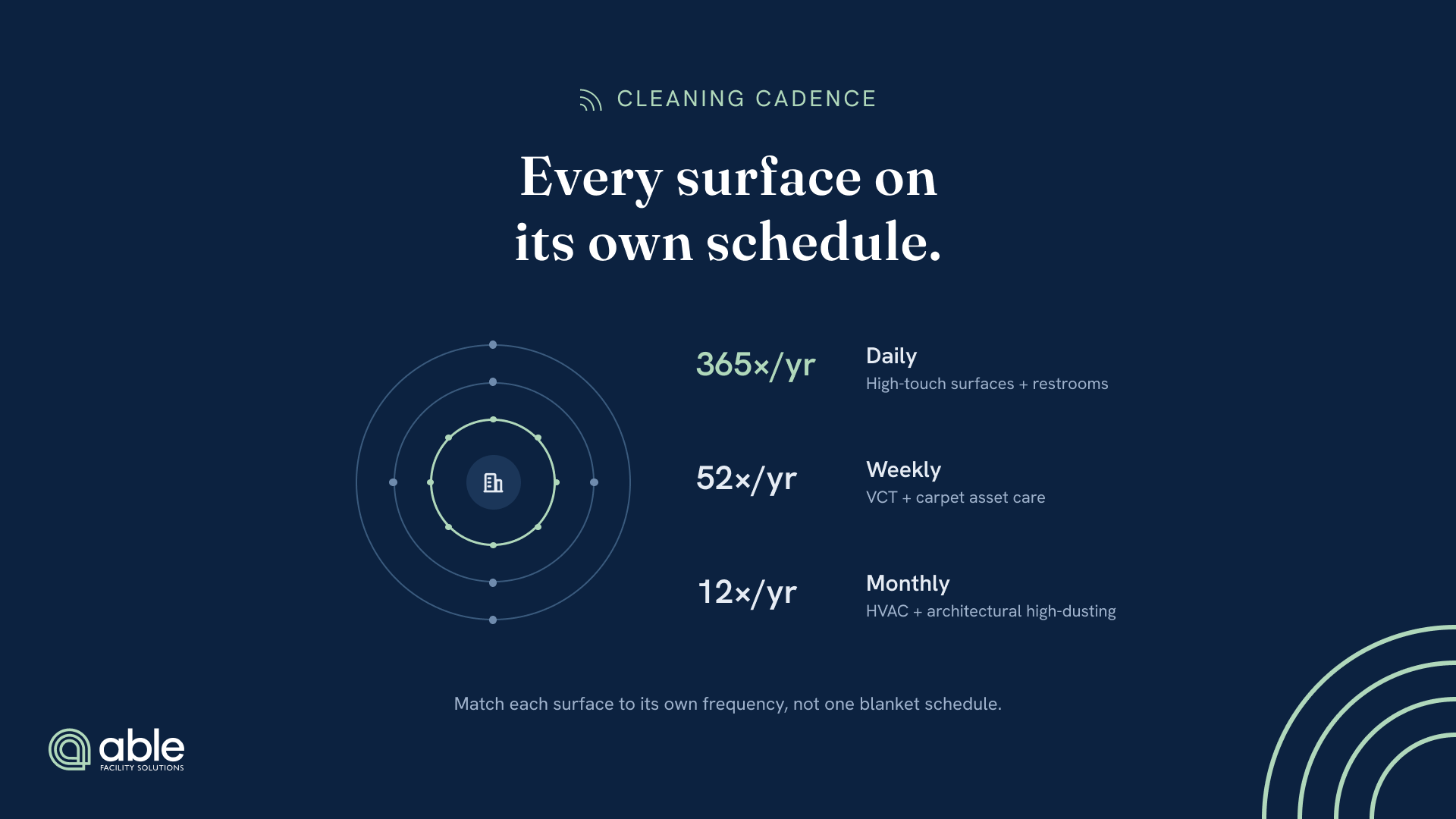
Daily tasks focus on immediate biological and aesthetic management, targeting areas where contamination risks are highest. Weekly and monthly tasks shift toward specialized maintenance, including deep floor care and high-level dust removal. Scheduling cleaning by exact traffic patterns and asset types prevents wasting the budget on looks over real sanitation. Understanding how often to clean your office based on density and foot traffic prevents both neglect and budget waste.
The main reason checklists fail in commercial office cleaning is a lack of control over the workers doing it. When regional contractors pass work to unvetted third-party crews, technical specifications are ignored. I reviewed this gap and found that real quality assurance needs direct staff supervision and clear performance metrics. It also requires following established frameworks, like APPA standards.
Daily maintenance: the high-touch protocol
Daily operations form the baseline of environmental safety in any corporate facility. High-traffic zones require structured, repetitive disinfection cycles to control pathogens and maintain standard building presentation. For large commercial properties in NJ, NY, and Philadelphia, a dedicated day porter service manages these tasks. It handles them in real time. It also reduces reliance on an evening crew.
Restrooms represent the highest risk area for environmental contamination and user dissatisfaction. Daily maintenance goes beyond restocking paper products to include clinical disinfection of all fixtures. For properties with heavy foot traffic, you need a clear breakdown of restroom cleaning frequencies. This helps protect facility assets and hygiene.
An entryway establishes the brand standard for tenants and visitors. Daily tracking ensures that glass surfaces, entry mats, and receptionist areas remain free of debris. To maintain these high-visibility environments, your team should execute a comprehensive daily facility cleaning protocol that targets essential high-traffic areas:
- Disinfecting all entry door handles, elevator buttons, and stair railings
- Emptying all waste receptacles and replacing liners
- Dusting and wiping down reception desks and hard surfaces
- Sweeping and mopping primary entrance flooring and walkways
- Cleaning and polishing water fountains and public digital displays
Maintenance frequency comparison
| Maintenance frequency | Primary objective | Key deliverable |
|---|---|---|
| Daily | Hygiene & sanitation | Pathogen control in high-traffic zones |
| Weekly | Asset preservation | Removal of abrasive soil from VCT and carpets |
| Monthly | Technical maintenance | HVAC efficiency and architectural high-dusting |
Weekly and monthly deep care: preserving VCT and HVAC
While daily cleaning manages immediate soil, weekly and monthly tasks focus on asset preservation and technical building health. Neglecting these areas leads to irreversible damage to expensive flooring and hurts indoor air quality.
VCT requires regular professional maintenance to prevent grit from destroying its protective finish. Monthly schedules must include machine scrubbing with neutral cleaners to remove embedded dirt. Regular technical floor care can extend the life of VCT by years. Using commercial floor cleaning services helps ensure these tasks are done with industrial-grade equipment. Preventing early floor replacement requires commercial cleaning services to be timed to match seasonal demands. Consistent commercial cleaning keeps high-traffic floors in peak condition year-round.
Accumulated dust in hard-to-reach areas directly impacts HVAC efficiency and tenant respiratory health. Monthly maintenance includes high dusting of light fixtures, ceiling vents, and architectural ledges. This helps stop particles from re-entering the air system. This task is often listed in a seasonal maintenance checklist. This protects indoor air quality and keeps workspace surfaces cleaner for longer periods.
The W-2 advantage: solving the accountability gap
A common flaw in traditional commercial cleaning contracts is the use of independent subcontractors. When a commercial cleaning company uses decentralized labor, it cannot require specific training methods. It also cannot enforce strict quality standards without breaking labor laws.
To ensure office cleaning services achieve clinical-grade compliance, the vendor should utilize a fully employed, W-2 workforce. Direct employment allows for mandatory safety training and strict operational accountability. Able Facility Solutions uses this model to ensure technical details are done right every time. This includes details in a 47-point inspection framework. This approach is backed by a 30-day guarantee to ensure brand standards are maintained in high-visibility environments.
Common questions about office cleaning checklists
Verification and ROI
- How do I verify if high-dusting was completed? Use a flash test on architectural ledges above six feet. If dust is present, the monthly schedule is not being followed.
- What is the most skipped item on a daily list? High-touch disinfection of elevator buttons and stair railings is frequently overlooked by unmanaged crews.
- How does VCT maintenance impact ROI? Regular monthly scrubbing helps prevent the need for a full strip-and-wax. A full strip-and-wax costs much more in labor and chemicals.
- Does APPA Level 2 require daily cleaning? Yes. To maintain a clean appearance without visible soil, daily intervention in high-traffic zones is mandatory.
Auditing your current service
If you suspect a provider is skipping essential tasks, move from passive observation to active quality management. These three steps help audit facility operations:
- 1Conduct a detailed walkthrough during active hours. Inspect high-touch surfaces, baseboards, and window sills for dust buildup.
- 2Review the current contract to verify if technical floor care, restroom cleaning, and high-dusting are clearly scheduled.
- 3Implement a structured system for a facility cleaning audit using APPA standards to establish objective cleanliness scores.
Cleanliness is a business asset. Maintaining a pristine facility requires both a thorough checklist and a disciplined W-2 workforce capable of executing it. Relying on an unmanaged vendor creates long-term operational risks that manifest as property damage and tenant turnover.
Not sure what your facility needs? Use our 60-second tool to build a tailored cleaning recommendation and cadence.